|
 Scotch-Irish, according to
Professor James Leyburn in his book,
Scotch-Irish: A Social History (1962), "is an
Americanism, generally unknown in Scotland and
Ireland, and rarely used by British historians". Scotch-Irish, according to
Professor James Leyburn in his book,
Scotch-Irish: A Social History (1962), "is an
Americanism, generally unknown in Scotland and
Ireland, and rarely used by British historians".
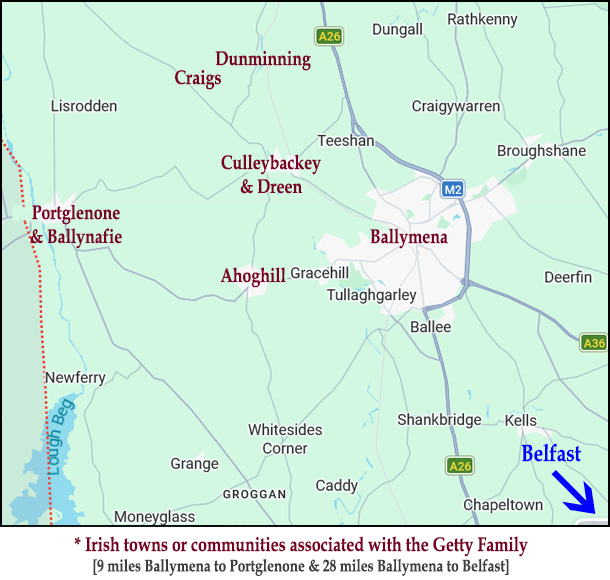
This was a term for
people who emigrated from the Lowlands of Scotland
or Northern England to the most northern area of
Ireland which was known as Ulster in the 17th
century but is now called
Northern Ireland.
In the 18th and 19th centuries, many of these people
(including the
Getty family) then left for the United States
where they were commonly referred to as
Scotch-Irish.
 Scotch was the usual
adjective for things pertaining to Scotland,
including people, until the 19th century, when it
was eclipsed by the term, Scottish. It survives in
certain set phrases, such as Scotch whisky and
Scotch broth, Scotch pine and in the term
Scotch-Irish. Scotch was the usual
adjective for things pertaining to Scotland,
including people, until the 19th century, when it
was eclipsed by the term, Scottish. It survives in
certain set phrases, such as Scotch whisky and
Scotch broth, Scotch pine and in the term
Scotch-Irish.
From 1710 to 1775,
over 200,000 people settled from Ulster to the
original thirteen American colonies with the largest
numbers settling in Pennsylvania. From that base
some went south into Virginia, the Carolinas and
across the South, with a large concentration in the
Appalachian region. Others headed west to western
Pennsylvania, Ohio, Indiana, and the Midwest.
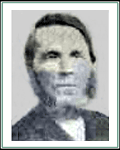
George Kilpatrick Getty (shown above) and his
family arrived in New York in 1852 when large
numbers of Irish were making the transition to
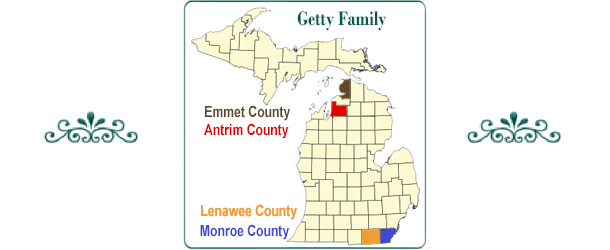
America. They eventually made their way to Lenawee
County in southeastern Michigan.
|