|
Bridge School Is Closed
After 119 Years Of Service
Monroe Evening News
September 14, 1946
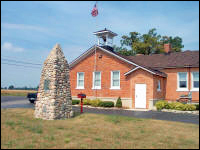 The Bridge School, recognized as Michigan’s first rural school, has
concluded 119 years of service to the residents of
Grape and its
surrounding farming area.
The school celebrated its centennial in 1928 and reunion gatherings
of its graduates were conducted regularly for many years. The Bridge School, recognized as Michigan’s first rural school, has
concluded 119 years of service to the residents of
Grape and its
surrounding farming area.
The school celebrated its centennial in 1928 and reunion gatherings
of its graduates were conducted regularly for many years.
The
decision to close the school was a difficult one to make, Edward H. Rath, director of the school board said, but it was made in the
belief that the children of the district could obtain better school
services at Dundee, about seven miles distant. The school
transported its seventh and eighth grade pupils to Dundee last year
and now is transporting the entire membership of 48 boys and girls.
A bus, driven by George Rath, now is being used with purchase of a
newer, modern school bus being considered.
 The building was in need of considerable repair and that also was a
factor in deciding to transport the youngsters to Dundee.
Walter
Grams (left), who succeeded Harrison Dentel as teacher at the school eight
years ago, now is teaching at the Heck School on Albain Road, also
in
Raisinville Township. The school board, in addition to Mr. Rath
includes Edward Miller, moderator, and Clarence Ziesmer, treasurer. The building was in need of considerable repair and that also was a
factor in deciding to transport the youngsters to Dundee.
Walter
Grams (left), who succeeded Harrison Dentel as teacher at the school eight
years ago, now is teaching at the Heck School on Albain Road, also
in
Raisinville Township. The school board, in addition to Mr. Rath
includes Edward Miller, moderator, and Clarence Ziesmer, treasurer.
The history of the Bridge School began April 7th, 1828, when a group
of trappers, hunters and farmers met to organize Raisinville
Township and the school district. During the summer, a building
“bee” was called to construct the tiny, one-room log school, erected
on the west line of George Sorter’s farm.
The school opened in the fall with seven pupils in attendance.
Teachers “boarded around” at the various farms, often walking long
distances to and from the school. The job was strictly for “he-men”
who could handle students of all ages, there being no age limit in
the early days. Clashes were frequent, and decisions went to the
pupil as often as to the master. In 1832, a larger building was
needed and it was constructed on the present location of the school,
one half mile east of the original site. The second building was
also made of logs.
Another, larger building was formed of two inch, black walnut plank
in 1843.This school house when replaced by the brick structure, was
removed to a nearby farm and used for many years as a carriage
house. The building always has been available for community
meetings, as evidenced by township records containing many accounts
of sessions “in the school house.”
|