|
Remembering Bridge School
On Its 150th Anniversary
- 1978 -
By Harold Stotz
  Saturday, June 23, 1928, was a big day for the residents and former
pupils of the Bridge School District. In observance of the 100th
Anniversary of its organization as the first public school in
Michigan, a stone monument was erected in front of the school at the
corner of Dixon and Ida Maybee Road. Saturday, June 23, 1928, was a big day for the residents and former
pupils of the Bridge School District. In observance of the 100th
Anniversary of its organization as the first public school in
Michigan, a stone monument was erected in front of the school at the
corner of Dixon and Ida Maybee Road.
Herbert Nickel had hauled the stones from the Davis quarry west of
Ida and the late Scobie Miller dug the hole for the foundation, but
no one seems to remember who did the masonry work.
There was a program which included a dedication and unveiling
ceremony. The youngest boy and girl in school, Geraldine Chambers
(Mrs. James Barron of Ida) and William Barnaby, Jr. of Dixon Rd.
pulled ribbons to unveil the monument.
Fifty years later, the monument and the building still stand, but
there are no pupils or teacher.
Of all the stories told about the long history of the school, one
story bears retelling because it shows that discipline problems were
solved in a different way years ago. In the 1890's, farm boys who
only could attend the winter term of school because of the demands
of farm work, often came to school until they were 21 or older.
During the winter term of 1892, these big boys rode the teacher out
of school on a rail.
A desperate school board hired Colton Clark, a
40 year old farmer who lived in the district to finish the term.
Mr. Clark came to school armed with several stout hickory sticks
which he showed to the 45 pupils and then informed them that he
intended to keep order. One young rebel promptly took a chew of
tobacco and spat on the floor. Teacher Clark used his hickory stick
so effectively that the boy didn’t come to school the next day.
Mr.
Clark left the school under the care of a trusted older student and
skated up the river to the boy’s home where he was told that the boy
was in bed claiming he didn’t feel well. Whereupon Mr. Clark went to
the boy’s room and informed him that, unless he came to school,
there would be another session with the hickory stick. The truant
quickly recovered from his illness and skated back to school with
the teacher. History does not record whether the young man acquired
his education, but at least, he learned not to interfere with the
education of others.
Although Bridge School never turned out many astronauts, lawyers or
professional basketball players, it did provide a good basic
education for its students who have become solid citizens of Monroe
County and who provide essential goods and services to their fellow
man. We think of people like farmers Wayne Chambers and
William Heiden; successful businessmen, Alva and Ivan Zorn; Time Container
employee Wes Cominess; secretary
Mrs. Wilma (Heiden) Bicking;
accountant,
Velda Heiden; carpenter, Al Miller and many others.
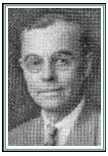 Harrison Dentel
(left) taught at Bridge School for 20 years. In 1928, he
had more than 40 students in eight grades and, at one time, there
were 56 scholars.
Somehow, Mr. Dentel was able to provide an education for this large
number of students without the help of a guidance counselor,
psychologist, remedial reading teacher, swimming pool or gymnasium.
He didn’t even have an administrative assistant and most of his
students were culturally and economically deprived by today’s
standards. They didn’t have indoor plumbing in the homes either. It
seems to us that modern educators could learn some lessons from the
history of Bridge School, but, perhaps, that is presumptuous of us.
Neither of us has a Ph.D. in education. Harrison Dentel
(left) taught at Bridge School for 20 years. In 1928, he
had more than 40 students in eight grades and, at one time, there
were 56 scholars.
Somehow, Mr. Dentel was able to provide an education for this large
number of students without the help of a guidance counselor,
psychologist, remedial reading teacher, swimming pool or gymnasium.
He didn’t even have an administrative assistant and most of his
students were culturally and economically deprived by today’s
standards. They didn’t have indoor plumbing in the homes either. It
seems to us that modern educators could learn some lessons from the
history of Bridge School, but, perhaps, that is presumptuous of us.
Neither of us has a Ph.D. in education.
|