|
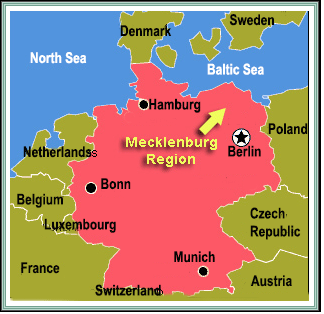 We
know very little about August Heiden’s life in Germany except
for the facts and figures found in the old church records. He
was born on Saturday, January 27, 1838 in the tiny village of
Gross Wokern in the province of Mecklenburg-Schwerin in northern
Germany. We
know very little about August Heiden’s life in Germany except
for the facts and figures found in the old church records. He
was born on Saturday, January 27, 1838 in the tiny village of
Gross Wokern in the province of Mecklenburg-Schwerin in northern
Germany.
August was baptized into the
Lutheran faith, on
February 4th, 1838 with August Hillmann,
Friedrich Froh and Anton Schreiber as his godparents. Hillmann
and Froh were “Tagelöhners” or wage laborers while Schreiber was
a “Webergeselle” which means he was a weaver’s apprentice. As
was the custom of the day, the child was christened with the
names of the godparents. That is why his full name is August
Friedrich Anton Theodor Heiden.
Life was probably a little
tougher for August than other kids because he was the son of an
unmarried mother who was employed as a house maid. Maria also
had a daughter out of wedlock so times might have been difficult
both economically and socially.
When he was six years old in
1844, August's mother married a man named Friedrich Stüve. Of
course we know nothing about how this affected August but it
probably improved his life somewhat.
 We do not know what kind of
schooling young August received in his native village. However,
judging by later documents and correspondence, it was clear that
he knew how to read and write in the German language. The fact
that he was able to complete the apprenticeship necessary to
become a brick mason meant that he knew arithmetic and how to
calculate angles required in building structures out of bricks. We do not know what kind of
schooling young August received in his native village. However,
judging by later documents and correspondence, it was clear that
he knew how to read and write in the German language. The fact
that he was able to complete the apprenticeship necessary to
become a brick mason meant that he knew arithmetic and how to
calculate angles required in building structures out of bricks.
During this period in Germany,
qualifying for a skilled trade such as brick mason was one of
the few ways a person could “get ahead.” It was probably quite
difficult to gain entrance into an apprenticeship and August
must have possessed those qualities necessary to impress members
of the local guild.
During this period of history
in the German provinces, it was law that every able bodied young
man had to serve two years in the
armed forces.
In the wooden box at
Agnes (Brockman) Heiden’s
house we found a document that deals with his discharge from
further military obligations. We do not know if he actually
served in the army of the local Dukedom.
Click Here for a translation of the document.
 It appears that August spent
his entire time in Germany in
Gross Wokern.
On February 21, 1868 at the age
of 30, he married Fredericka Knaack and, according to the church records, they
already had a two year old son,
Heinrich, at that time. Their second child, Ernst, would be born
on June 10, 1868. It appears that August spent
his entire time in Germany in
Gross Wokern.
On February 21, 1868 at the age
of 30, he married Fredericka Knaack and, according to the church records, they
already had a two year old son,
Heinrich, at that time. Their second child, Ernst, would be born
on June 10, 1868.
This was not unusual for the times since
the Duke who ruled over a section of Germany had to give his
consent before a subject could be married. They were reluctant to
give such consent during the second half of
the nineteenth century because the area was undergoing a
population explosion and they did not want to encourage more
families being formed.
Many of the people in these regions were employed as serfs which
is about one step above slavery. The workers for a particular
landowner were under his control and could not move to another
job without his approval. On the other hand, the landowner was
responsible for the upkeep of the workers on his land. So,
allowing people to marry and start raising more children only
added to his financial burden. He needed fewer workers, not
more.
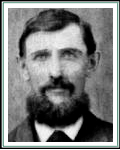
Another inhabitant of
Gross Wokern was
Heinrich Rambow. There is little doubt that he knew
August and their paths would cross throughout the rest of their
lives. August and his family left Germany in 1873 and made their
way to
Raisinville Township, Monroe County, Michigan. Heinrich
and his family including his wife's Milhan siblings, made the same journey in 1874 and
eventually found a farm a
few miles down the road from the Heidens. It is also reported
that August Heiden built the Rambow house on South Custer Road.
Finally, two of Heinrich's daughters, Mary and Fredaricka,
married two of August's sons, Wm Carl and Herman, respectively.
For a list of August Heiden's
ancestors in Germany,
click
here.
 |










 Knaack - Knack - Kanak - Knaak -
 In
researching Rika's background, the old German church records most
frequently spell it Knaack. In America, we find the occasional Knaak or
Kanack. Since Knaack appears to be the accepted German spelling, that is
what we will use...for now.
In
researching Rika's background, the old German church records most
frequently spell it Knaack. In America, we find the occasional Knaak or
Kanack. Since Knaack appears to be the accepted German spelling, that is
what we will use...for now. Anna
in her newspaper
Anna
in her newspaper