|
 |
|
 |
|
|
|
|
|
 |
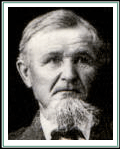
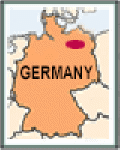 August Friedrich Anton Theodor Heiden was born Saturday, January 27,
1838 in the Village of Gross Wokern in the province of
Mecklenburg-Schwerin
in the northern part of Germany (in red on the map). He spent his youth there, got married there and started
his family in that little town before coming to America in 1873. August Friedrich Anton Theodor Heiden was born Saturday, January 27,
1838 in the Village of Gross Wokern in the province of
Mecklenburg-Schwerin
in the northern part of Germany (in red on the map). He spent his youth there, got married there and started
his family in that little town before coming to America in 1873.
According to the local church records, August was born to the
unmarried "madchen" i.e. housemaid, named
Maria Heiden. In
the space for the father's name was the German word "angeblich"
which means alleged to be followed by the name,
Johann Cansier. As we have followed this name
back in the records, it has been spelled
differently many times but it appears that the name should probably
be Kanseyer. August, of course, was listed under his mother's name,
thus we are all Heidens and not Kanseyers.
 The area where August lived was comprised of several towns, each with fewer
than 1,000 inhabitants. They were spaced a few miles apart and
people probably just walked between them. August's wife whom he
married on February 21, 1868,
Elisabeth Sophia
Wilhelmina Friedericka "Rika" Knaack lived in the village of
Mamerow about 4
miles away. We have included details on these small communities and how they
relate to the Heiden family and other relatives. The area where August lived was comprised of several towns, each with fewer
than 1,000 inhabitants. They were spaced a few miles apart and
people probably just walked between them. August's wife whom he
married on February 21, 1868,
Elisabeth Sophia
Wilhelmina Friedericka "Rika" Knaack lived in the village of
Mamerow about 4
miles away. We have included details on these small communities and how they
relate to the Heiden family and other relatives.
During his early life, August must have gone through an
apprenticeship because he listed his occupation as brick mason when
he left for America. In the 1920s when relatives from Germany
sent
letters to him and his wife, they addressed them to Maurer
August Heiden. That is the German word for brick layer and it must
have warranted the use as a title of sorts.
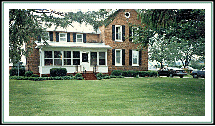 In
the U.S. it appears that August made his living farming and building
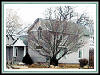
houses. The story is that he did the brickwork on what eventually
became his third son, William Carl's house at
8861 Dixon Road
(left). He
also is credited with building the house of fellow immigrants from
Gross Wokern and
future in-laws, Heinrich and Wilhelmine
(Milhan) Rambow at
7400 South Custer
Road (M-50). In
the U.S. it appears that August made his living farming and building
houses. The story is that he did the brickwork on what eventually
became his third son, William Carl's house at
8861 Dixon Road
(left). He
also is credited with building the house of fellow immigrants from
Gross Wokern and
future in-laws, Heinrich and Wilhelmine
(Milhan) Rambow at
7400 South Custer
Road (M-50).
 Whatever
he did, August was certainly successful because in less than 20
years in this country, he owned two small farms in Raisinville Township.
After living in the
City of Monroe when they first arrived, the
family would make their long-term home at a small farm at
8700 South
Custer Road (M-50). Whatever
he did, August was certainly successful because in less than 20
years in this country, he owned two small farms in Raisinville Township.
After living in the
City of Monroe when they first arrived, the
family would make their long-term home at a small farm at
8700 South
Custer Road (M-50).
August and his wife, Rika, had eight children with six of them
surviving to adulthood. Three were born in Germany (Heinrich, Ernst
and Meta) and five in the
U.S. (Wm Carl, Bertha, Herman, Lena Koster and John) They are covered in more detail
in Subtopic 6 below.
 On September 5, 1922, August died at his home at the age of 84.
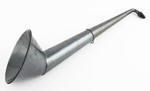
In his later years, he was known to be hard of hearing and used an
ear horn. He also suffered at least partial blindness which may have
been due to cataracts. He is buried at the
St Matthew Lutheran
Church cemetery. On September 5, 1922, August died at his home at the age of 84.
In his later years, he was known to be hard of hearing and used an
ear horn. He also suffered at least partial blindness which may have
been due to cataracts. He is buried at the
St Matthew Lutheran
Church cemetery.
|
 |
|
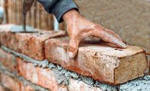 August
Heiden was trained as a bricklayer/mason or Maurer in German. In
19th century Germany, this involved starting as an apprentice (Lehrlin)
and then moving into the next level as a journeyman (Geselle).
Often this involved traveling around the region to gain different
experience and eventually, if you passed all the requirements, you would
become a master craftsman (Meister). The whole process was usually under
the guidance of a specific craft guild which set the rules for gaining
each step. August
Heiden was trained as a bricklayer/mason or Maurer in German. In
19th century Germany, this involved starting as an apprentice (Lehrlin)
and then moving into the next level as a journeyman (Geselle).
Often this involved traveling around the region to gain different
experience and eventually, if you passed all the requirements, you would
become a master craftsman (Meister). The whole process was usually under
the guidance of a specific craft guild which set the rules for gaining
each step.
Some of the
letters sent from Germany in the 1920s were addressed to Maurer
August Heiden so it must have been a special title. In America, it
appears that he worked both as a mason and a carpenter. He is said to
have built the house at
7400
South Custer Road where the
Heinrich Rambow
family lived. Along with one of his sons,
William Carl, he put
the brick facade on the house at
8861 Dixon Road
which would later be William's home farm. They also built a building in
Grape for
Raisinville Township in 1891. |
|
|
 |
|
|
 |
|
|
|
|
|
 |
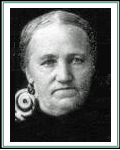 Elisabeth
Sophia Wilhelmina Fredericka Adolphine "Rika" Knaack
(right) was born
Wednesday, November 3, 1841 in
Mamerow about 4 miles away from her
future husband's town of
Gross Wokern. Elisabeth
Sophia Wilhelmina Fredericka Adolphine "Rika" Knaack
(right) was born
Wednesday, November 3, 1841 in
Mamerow about 4 miles away from her
future husband's town of
Gross Wokern.We know nothing of her
early years or how she and August eventually got together. In those
days in Germany, most people worked on the estate of a duke or other
powerful person. People had to get the landowner's permission to get
married and this was not easy since the area was experiencing an
over-population problem. Since the landowner was responsible for the
people on his property, they were reluctant to allow people to marry
and contribute to even more mouths to feed.
This was probably a contributor to the fact that August and
Rika's first child, Heinrich was born in 1866 and their marriage
took place in 1868, a few months before the birth of their second
child, Ernst.
The couple experienced more than their share of grief during
their lives. Just 12 days after they
arrived in New York and made
their way to Monroe, Michigan, their third child,
Meta, died at the
age of 2½. In 1876, they had fraternal twins,
Herman and
Bertha but
the girl died when she was only 6 months old. In June of 1922, their
55 year old son, Heinrich, collapsed in the field with a heart
attack and died. Two months later in September, August passed away
at the age of 84.
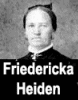
In the 1920s after August died, descendants of his half-sister,
Friedericka (Heiden) Schmidt, sent heart wrenching letters from
Germany asking for financial help. Germany was in the grip of hyperinflation following
the end of World War I in 1918 and these relatives were having a
very hard time. From the letters we have included here, it appears
that she was able to help at least a little.
Rika passed away on January 14, 1926 also at the age of 84. She
too is buried at
St Matthew Lutheran
Church cemetery.
|
|
|
|
|
|
|
|
|
|
 |
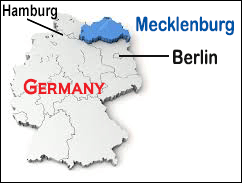 Before
emigrating to Monroe County, Michigan in 1873, this
branch of the Heiden Family originated in the
northern Germany province of
Mecklenburg-Schwerin. The
ancestors of the modern day family members were born
and raised in tiny villages surrounded by farms
owned by the Dukes or other elites of the day. After World War II,
this area was included in the former East German
Democratic Republic but is now part of the
re-unified Germany. It is now known as
Mecklenburg-Vorpommern. Before
emigrating to Monroe County, Michigan in 1873, this
branch of the Heiden Family originated in the
northern Germany province of
Mecklenburg-Schwerin. The
ancestors of the modern day family members were born
and raised in tiny villages surrounded by farms
owned by the Dukes or other elites of the day. After World War II,
this area was included in the former East German
Democratic Republic but is now part of the
re-unified Germany. It is now known as
Mecklenburg-Vorpommern.The area where August and
Rika lived was comprised of several towns with fewer
than 1,000 inhabitants each. They were spaced a few miles apart and
people probably just walked between them. August's wife,
Elisabeth Sophia
Wilhelmina Friedericka "Rika" Knaack lived in the village of
Mamerow about 4
miles away.

Our ancestors in the
Rambow and
Milhan
families also originated in this area. The
Roggermans were from Rügen Island, Germany which is
about 80 miles northeast from Gross Wokern.
We have included details on these small communities and how they
relate to the Heiden family and other relatives.
|
|
|
|
|
|
 |
|
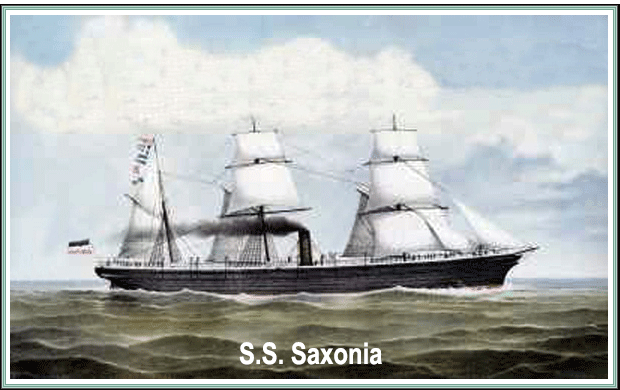
Like so many other common German folks of that era, August and Rika decided
that there was a better future for them and their family in America. Times
were tough in Germany for the working class, so many people chose to emigrate
even though the outside world was unknown to them.
The Heidens' journey led them to the port city of
Hamburg and on to New York
aboard the S.S. Saxonia
in June of 1873. Within a few short weeks after their arrival, they were in Monroe, Michigan to start
their new lives.
|
|
|
|
|
|
|
|
 |
  August and Rika began their American life in
1873 in the
City of Monroe,
Michigan. August probably worked at his trade as a brick mason
building houses and within a relatively short period, he was the
owner of two pieces of farm property in nearby
Raisinville Township. August and Rika began their American life in
1873 in the
City of Monroe,
Michigan. August probably worked at his trade as a brick mason
building houses and within a relatively short period, he was the
owner of two pieces of farm property in nearby
Raisinville Township.
He and his family eventually settled in a house on a farm on
South Custer Road where August and Rika lived for the rest of their lives.
Their youngest son, John and his wife, Agnes, lived there until her
death in 1981.
Through U.S. Census reports and plat maps, we have been able to
trace the family's progress through the 1920s. August died in 1922
and Rika passed in 1926.
|
|
|
|
|
|
|
|
 |
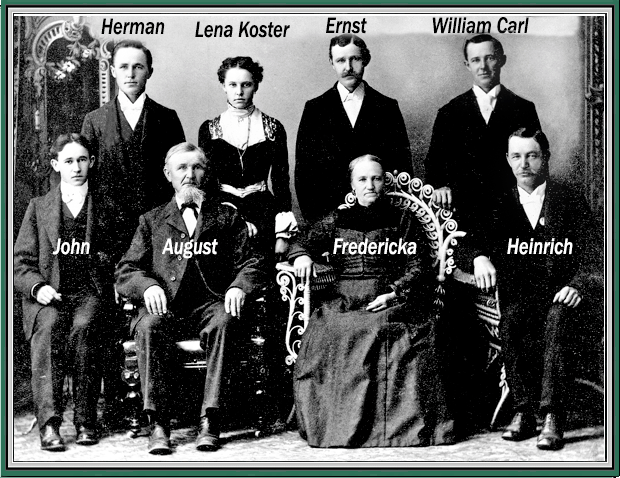 |
| August and Rika (Knaack) Heiden had eight
children. Six survived to adulthood including
Heinrich and
Ernst
(Ernest) who were born in Germany and
William Carl,
Herman,
Lena (Koster)
and John who were born in America.
Germany born Meta, died in
infancy two weeks after the family reached Monroe, Michigan in 1873.
Bertha and Herman were
fraternal twins born in 1876 but she died in January, 1877.
The children were
quite prolific and they produced
38 grandchildren and
105 great
grandchildren for August and Rika. Through 1995 when
The Heiden Family book was
produced, there were several hundred more descendants of
August and Rika (Knaack) Heiden. There are bound to be many,
many more now, thirty years later but we have not been able to keep up to date on
births.
|
|
|
 We
have developed a list of all the people who are direct descendants
i.e. share DNA,
of August and Rika. Unfortunately, as mentioned above this listing
is missing many people born after 1995. If you can help us We
have developed a list of all the people who are direct descendants
i.e. share DNA,
of August and Rika. Unfortunately, as mentioned above this listing
is missing many people born after 1995. If you can help us
 to update
the information, it would be greatly appreciated. to update
the information, it would be greatly appreciated. |
|
|
|
 |
|
|
|
 |
|
|
|
|
|
|
|
|
|
 |
|
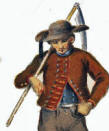 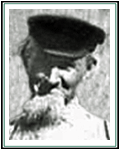 According to the
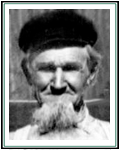
German church records, August Heiden's (left) father
was "alleged to be" a man named
Johann Canseir. As
we followed that person back in the German
records, it
appears more likely that the actual surname was probably Kanseyer. According to the
German church records, August Heiden's (left) father
was "alleged to be" a man named
Johann Canseir. As
we followed that person back in the German
records, it
appears more likely that the actual surname was probably Kanseyer.
Inconsistencies in name spellings were common in
the old records due to the general illiteracy
in those times. Various record keepers, such
as the local pastor, had to figure
out spelling based on the spoken word alone. |
|
|
|
|
|
|
|
 |
 The maiden name
of August's wife, Rika, was Knaack. Again, this
is a name that had a variety of spellings in the
old records. The maiden name
of August's wife, Rika, was Knaack. Again, this
is a name that had a variety of spellings in the
old records. |
|
|
|
|
|
 |
 The
maiden name of Rika Heiden's mother was Dreier. This branch
of the family leads to the relationship with the Laas and Regelin families who settled in Toledo,
Ohio and Monroe County respectively. The
maiden name of Rika Heiden's mother was Dreier. This branch
of the family leads to the relationship with the Laas and Regelin families who settled in Toledo,
Ohio and Monroe County respectively. |
|
|
|
|
|
 |
 In the early to
later 1900s, members of the Laas and Burmeister families were
regular attendees at the annual Heiden Family
Reunions. They were related to the family
through the Dreier connection to Rika Heiden. In the early to
later 1900s, members of the Laas and Burmeister families were
regular attendees at the annual Heiden Family
Reunions. They were related to the family
through the Dreier connection to Rika Heiden. |
|
|
|
|
|
 |
 A family by this name lived in Monroe County
near the homes of many of the Heidens. They were
related through the same branch as the Laas
Family. A family by this name lived in Monroe County
near the homes of many of the Heidens. They were
related through the same branch as the Laas
Family. |
|
|
|
|
|
 |
 |
|
|
|







 Knaack - Knack - Kanak - Knaak -
 Anna
in her newspaper
Anna
in her newspaper