|
 |
 |
|
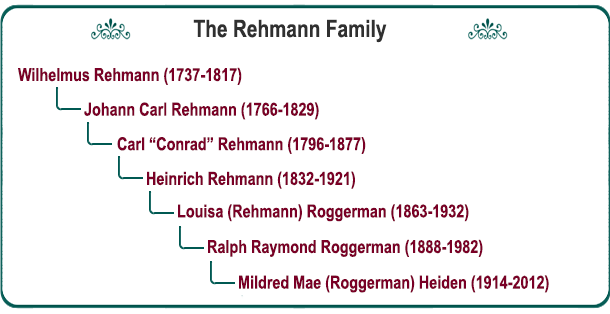
  Carl Heinrich Conrad "Conrad"
Rehmann Carl Heinrich Conrad "Conrad"
Rehmann was born on October 2, 1796 in Thedinghausen, Luneberg
National District, Lower Saxony, Brunswick, Germany. His parents
were
Johann Carl Nicholas and Margaretta (Oldenberg) Rehmann. was born on October 2, 1796 in Thedinghausen, Luneberg
National District, Lower Saxony, Brunswick, Germany. His parents
were
Johann Carl Nicholas and Margaretta (Oldenberg) Rehmann.
He married Sophie Heineke on
Wednesday, July 4, 1821. She had been born on October 22, 1797
in Hanover, Germany.
At the time of the marriage, he
was list as a "Häusler in der Bürgerei" which translates as a
"Cottager in the community". (See below)
They had eight children:
-
Margaretta Rehmann
-
Elisabeth "Liese" (Rehmann)
Kempker (1823-1876)
-
Charles Rehmann
(1826-1892)
-
Anna Marie (Rehmann)
Huester
-
Heinrich Frederick "Henry" Rehmann
(1832-1921)
-
Dorothea "Dora" (Rehmann)
Doerfel (1836- )
-
Wilhelm Rehmann
(1839-1869)
-
Christopher Rehmann,
Sr.
(1842- )
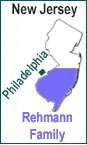 In April of 1852, Conrad, Sophia
and family boarded the
SS Louise Marie for the trip to
America. They landed in Philadelphia on May 6th. Conrad became a
naturalized citizen of the U.S. on January 20, 1859 in
Philadelphia. In April of 1852, Conrad, Sophia
and family boarded the
SS Louise Marie for the trip to
America. They landed in Philadelphia on May 6th. Conrad became a
naturalized citizen of the U.S. on January 20, 1859 in
Philadelphia.
At the time of Conrad's death on
February 4, 1877 at the age of 81, they were living in Folsom
Borough, Buena Vista Township, Atlantic County, New Jersey. This
is about 35 miles east of Philadelphia. He was buried at the
Zions Reformed Lutheran Church cemetery in Folsom Borough, Buena
Vista Township, New Jersey.
Sophie passed away on January 14,
1880 at the age of 82 while living in Hammonton in Hamilton
Township, Atlantic County, New Jersey. She is also buried at the
Zions Reformed Lutheran Church cemetery. |
|
 |
 |
|
Häusler = Cottager: A German cottager (historical) was
a rural worker or petty commodity producer who owned a small house,
a garden, and minimal land for animals. Because
their plots were too small to sustain a family, they relied heavily on
wages and supplemental "cottage industries," such as weaving or
spinning. |
|
|
 |
|
|
 |
|
|
|
 |
|
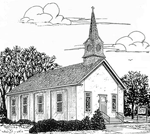 In
the Rehmann Family many events since the mid-19th century
have occurred at two churches located at 1341 Mays Landing
Road in Folsom, New Jersey. (Some sources list the address
being in Hammonton, NJ.) There can be some confusion since
names of these churches are spelled in slightly different
ways depending on the date or the document. In
the Rehmann Family many events since the mid-19th century
have occurred at two churches located at 1341 Mays Landing
Road in Folsom, New Jersey. (Some sources list the address
being in Hammonton, NJ.) There can be some confusion since
names of these churches are spelled in slightly different
ways depending on the date or the document.
Starting in 1848, the
original church was established as St Jacobus Lutheran
Church to serve the local German immigrants. It was located
on a 12 acre plot of land which included a cemetery.
In 1853, conflicts over
theological issues caused a split in the congregation. The
land was divided into two six acre sites and one was used to
construct what is now St James Lutheran Church, originally
St James Evangelical Church.
Charles Rehmann (1826-1892) was on the St. James
committee. A second facility called Zion
Evangelical & Reformed Church was founded at that time. It
is sometimes listed as Zion's or Zions.
About 1998 around the 150th
anniversary of the original church, the two congregations
reunited into St James Lutheran Church. The cemetery is
often referred to by either name, St. James or Zion. |
|
|
|
|
|
|
|
|
 |
|
|
 |
|
|
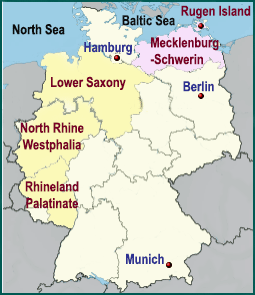
Of the ten
families covered on this website, eight
originated in Germany. Members emigrated to
America from the mid to late 19th century. The
Heiden,
Rambow,
Knaack,
Kanseyer,
Dreier and
Milhan
families all lived in the
Mecklenburg-Schwerin region (now called
Mecklenburg-Vorpommern) We have followed the
Roggerman family back to
Rügen Island in the Baltic Sea.
So far, in the documentation for the German
members of the
Rehmann
family, places in Lower Saxony, North
Rhine-Westphalia and Rhineland-Palatinate have
appeared. We will continue to investigate this
unusually widespread distribution in the future. |
|
|
|
|
|
|
|
 |
|
|
|