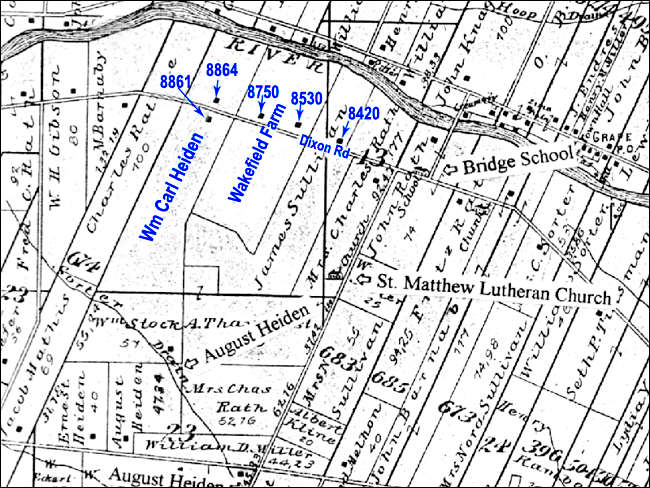
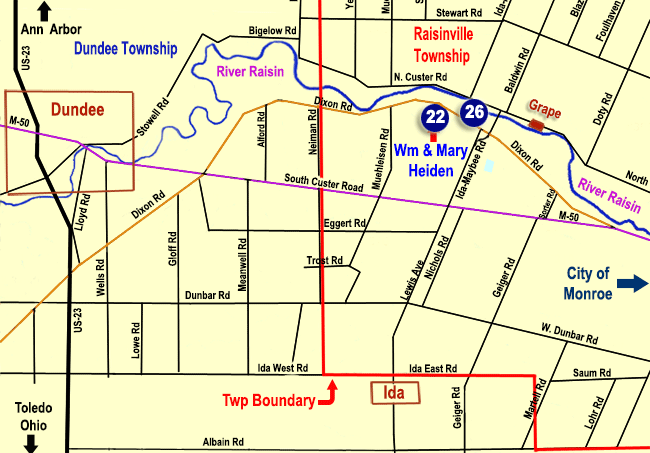
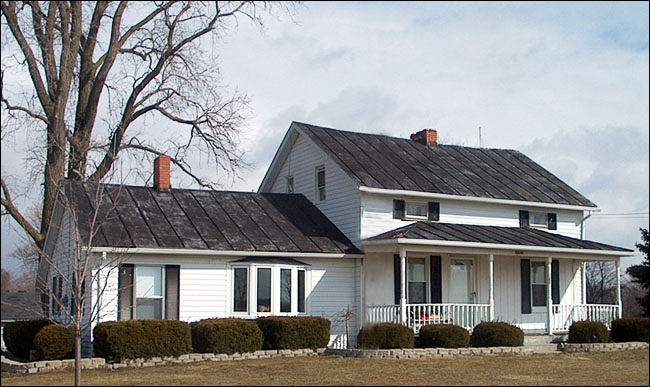
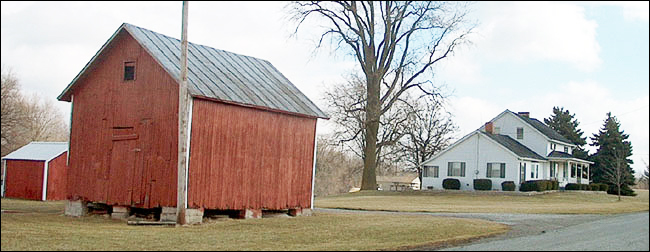
 Several different branches of the
Heiden family have lived at this location spread out over many decades.
William
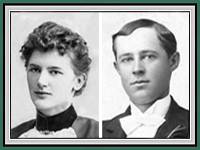
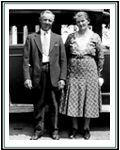
Carl and Mary (Rambow) Heiden (right) lived here for one
year following their marriage in 1897. They then moved to
the Eby farm at
8130 South Custer Road, about 2.5 miles to the east.
Several different branches of the
Heiden family have lived at this location spread out over many decades.
William
Carl and Mary (Rambow) Heiden (right) lived here for one
year following their marriage in 1897. They then moved to
the Eby farm at
8130 South Custer Road, about 2.5 miles to the east.
The 1910
U.S. Census shows
Heinrich Heiden (Wm Carl's older brother) and his family living at this
address and owning i.e. buying, the farm. As far as we can tell, all seven of
his children including,
August John Heiden,
Wm Leo Heiden,
Elsie (Heiden) Klatt,
Dorothy (Heiden) Strzesinski,
Esther (Heiden) Kehrer,
Henry Wm Heiden and
Libbie (Heiden, Frank) Murdock were born in this house.
 In 1922, at the age of 55,
Heinrich was working in the fields and keeled over dead from a
heart attack. It appears that Emma continued to live there for
several more years and in 1925, she hosted
the annual Heiden Family Reunion at this farm.
Sometime later, the farm was sold to Andrew Shucik who lived
in the Detroit area.
In 1922, at the age of 55,
Heinrich was working in the fields and keeled over dead from a
heart attack. It appears that Emma continued to live there for
several more years and in 1925, she hosted
the annual Heiden Family Reunion at this farm.
Sometime later, the farm was sold to Andrew Shucik who lived
in the Detroit area.
Emma and her children Dorothy (Heiden) Strzesinski
(23), Esther (Heiden) Kehrer (20), August John
Heiden (28) and Libbie Murdock (14) moved to
617 Eighth
Street in Monroe where they were living at the time of the 1930 U.S. Census .
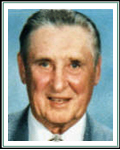 In 1951,
Wm Frank and Helen
(Henning) Heiden with their children,
Carol, Janice,
James,
Dianne (Heiden) Houpt, Richard
Carl and Gene moved from William's parents'
house at
8861
Dixon Road to this house about 1/2 mile east. In
1954, their daughter, Cheryl was born while they lived
at this farm.
In 1951,
Wm Frank and Helen
(Henning) Heiden with their children,
Carol, Janice,
James,
Dianne (Heiden) Houpt, Richard
Carl and Gene moved from William's parents'
house at
8861
Dixon Road to this house about 1/2 mile east. In
1954, their daughter, Cheryl was born while they lived
at this farm.
In 1960, Wm bought his father,
Wm Carl Heiden's
farm and moved back to 8861 Dixon.
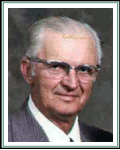 In
1964,
Arthur and Mildred (Roggerman) Heiden moved from their home at
8864 Dixon to this farm.
At that time, their
children living at home were Ralph, Kay and Gail.
In
1964,
Arthur and Mildred (Roggerman) Heiden moved from their home at
8864 Dixon to this farm.
At that time, their
children living at home were Ralph, Kay and Gail.
In 1976, Roger Barnes who had grown up next door at
8750 Dixon Road bought the house. Art
retired from Dundee Products Co. and he and Mildred and Gail moved back to
8864 Dixon.
Over the decades, a total of 25 members of the Heiden Family
lived in this house.


 From the 1950s to at least the 1970s, the house had brown
asphalt stucco type siding and looked much different from
the house shown above. The picture below shows the pattern
of the siding and its actual color.
From the 1950s to at least the 1970s, the house had brown
asphalt stucco type siding and looked much different from
the house shown above. The picture below shows the pattern
of the siding and its actual color.

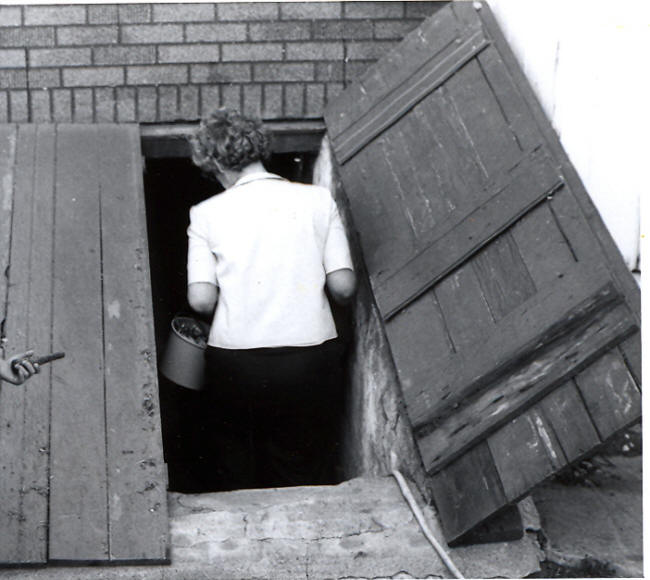
When we lived here,
there was still a wood or coal fired furnace in the basement. My
dad would go down first thing in the morning and "stoke" the
fire with more wood or coal.
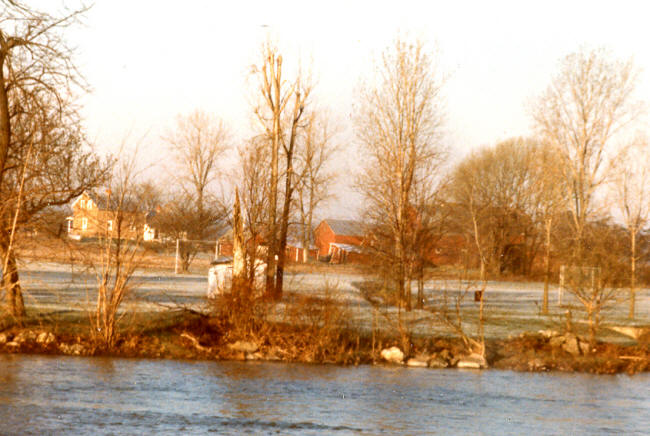
Behind and on the eastern
boundary of the property was a park on the river. There is a dam
across the river at that point and the facility was once open for use by
groups. There was a small building where you could buy
refreshments but by the time we lived here in the 1960s it was
no longer functioning.
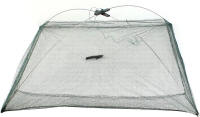 In
the spring when the river flooded the lowlands to the north of the house,
we would sneak down to the dam at night to dip net for Northern pike.We
used a 4 by 4 foot square net attached to the end of a long pole.
You would lower the net into the water, wait a few minutes and then pull
it up
to see if you caught something. Since the fish were in spawning
mode, they were always moving around and we usually caught a few
each night.
In
the spring when the river flooded the lowlands to the north of the house,
we would sneak down to the dam at night to dip net for Northern pike.We
used a 4 by 4 foot square net attached to the end of a long pole.
You would lower the net into the water, wait a few minutes and then pull
it up
to see if you caught something. Since the fish were in spawning
mode, they were always moving around and we usually caught a few
each night.
 The
reason we went at night was because what we were doing was
illegal. We had to keep an eye out for the conservation officer
so we rarely used a flash light. One night, a car showed up at
the gate on the driveway from the road which was perhaps 1/4 mile away
from the river. We quickly
folded everything up, grabbed the fish which were kept in a
burlap bag in the water and hustled for the house.
The
reason we went at night was because what we were doing was
illegal. We had to keep an eye out for the conservation officer
so we rarely used a flash light. One night, a car showed up at
the gate on the driveway from the road which was perhaps 1/4 mile away
from the river. We quickly
folded everything up, grabbed the fish which were kept in a
burlap bag in the water and hustled for the house.
Turned out it was the State
Police and they came to our house to see if anyone had noticed
activity on the river. We were hiding in the barn watching
through cracks in the siding, scared stiff.
Fortunately, they just left after talking to my mother without
looking around for us and we never heard from them again.
But, we kept on fishing.







 In
1952, in honor of their 55th wedding anniversary, D.N. Roberts, known as
The County Visitor, interviewed Wm Carl and Mary for an article which
appeared in the
In
1952, in honor of their 55th wedding anniversary, D.N. Roberts, known as
The County Visitor, interviewed Wm Carl and Mary for an article which
appeared in the
 "Mr and Mrs.
Heiden rented a farm just east of their
present home on the same road. The farm is
known now as the Albert Adler farm. [
"Mr and Mrs.
Heiden rented a farm just east of their
present home on the same road. The farm is
known now as the Albert Adler farm. [ The
actual addresses [ ] were taken from the 1950
U.S. Census for Raisinville Township for the
Adler, Eby and Albright properties as
mentioned in the news article.
The
actual addresses [ ] were taken from the 1950
U.S. Census for Raisinville Township for the
Adler, Eby and Albright properties as
mentioned in the news article.
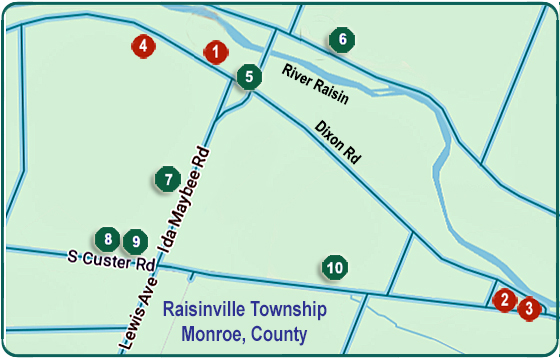


 It
is 3.0 miles from #3 to #4
It
is 3.0 miles from #3 to #4

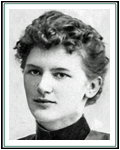


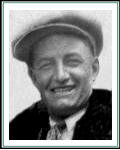
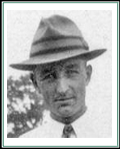
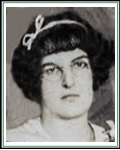













 Like
a lot of pieces of family history, we do not know how
Like
a lot of pieces of family history, we do not know how

 Not only did August seem to prosper but his two
sons,
Not only did August seem to prosper but his two
sons,

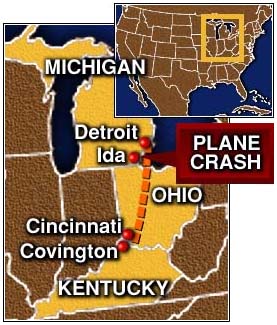 MONROE COUNTY, Michigan (CNN) -- In frigid weather, bodies and
debris from the crash of a commuter plane near Detroit were
being brought to a nearby hangar on Friday. Federal
investigators planned to search for the cockpit voice and flight
data recorders from Comair Flight 3272 once the bodies of all 29
victims were recovered.
MONROE COUNTY, Michigan (CNN) -- In frigid weather, bodies and
debris from the crash of a commuter plane near Detroit were
being brought to a nearby hangar on Friday. Federal
investigators planned to search for the cockpit voice and flight
data recorders from Comair Flight 3272 once the bodies of all 29
victims were recovered. Flight 3272 was enroute from Cincinnati when it went down just
before dusk about seven miles west of Monroe and about 18 miles
southwest of its
Flight 3272 was enroute from Cincinnati when it went down just
before dusk about seven miles west of Monroe and about 18 miles
southwest of its
 destination, Detroit Metropolitan Airport.

 The
river was named "Riviere aux Raisin" by the French-Canadian people
that first settled in Monroe County. They called it the River Raisin
because of the wild grapes growing along its banks. This led to the
naming of
The
river was named "Riviere aux Raisin" by the French-Canadian people
that first settled in Monroe County. They called it the River Raisin
because of the wild grapes growing along its banks. This led to the
naming of