|
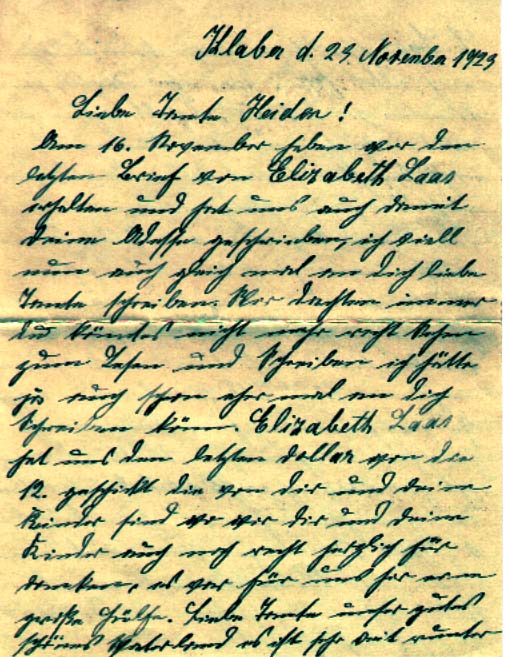
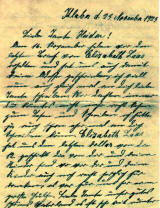 Ralph Heiden - The letters are rather sad overall. They were having some
very tough times in Germany then and they were always asking their
Aunt Rika, my great grandmother, for money. Ralph Heiden - The letters are rather sad overall. They were having some
very tough times in Germany then and they were always asking their
Aunt Rika, my great grandmother, for money.
Mildred (Roggerman) Heiden - In one of them, they ask for some money for a house and
some land. Then, later they say they bought the house but needed
more money for the land.
Marie (Heiden) Tommelein - Did they ever help them?
Ralph Heiden - Yes, they sent money when they could and they were always
very appreciative of it and told what the money would buy.
Brick Tommelein - My dad said that at that time, everyone over in Europe
called America “the land of opportunity.”
Ralph Heiden - A lot of people here were helping their relatives then too.
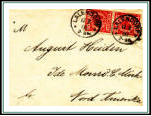
In one of the letters, they ask Rika to send her letters registered
because people were stealing things from mail from America because
those envelopes were likely to have money in them.
Helen (Henning) Heiden - Now are these letters all from
Mecklenburg?
Ralph Heiden - Yes. They are from the area called Mecklenburg and the port
city of Rostock. The little villages where our ancestors came from
are the size of
Grape and Maybee and they are about 50 miles from
Rostock.
 Helen (Henning) Heiden - From the Hennings, I heard them say that the people were
like slaves back then in Germany. They worked for all these big rich
people. They provided pay for them and took care of them but they
couldn’t get ahead. They didn’t want them to get married because
there were already too many of them to take care of. That is where
the Hennings came from too. Helen (Henning) Heiden - From the Hennings, I heard them say that the people were
like slaves back then in Germany. They worked for all these big rich
people. They provided pay for them and took care of them but they
couldn’t get ahead. They didn’t want them to get married because
there were already too many of them to take care of. That is where
the Hennings came from too.
Mildred (Roggerman) Heiden - Didn’t you say that our name should be something other
than Heiden?
Ralph Heiden - Yes, my great grandmother,
Maria Heiden, did not marry the
father of August. So, he took her name rather than his father’s
which was
Kanseyer
or Canseyer.
Helen (Henning) Heiden - That’s the same way with my grandpa Henning. Grandma wasn’t
married when she had those two kids.
Ralph Heiden - That was a real common occurrence back then.
Mildred (Roggerman) Heiden - They wouldn’t let you get married unless you could support
yourself.
Ralph Heiden - They technically weren’t slaves but there was nowhere else
for them to go except to another big estate to work and they were
full too. Also, the landowner had the responsibility to take care of
the people on his land so he was stuck too.
That is why they pushed a lot of them to leave and go to America.
Also, the illegitimacy rate went way up because even though they
weren’t legally allowed to marry, people continued to form couples
and do what they needed to do.
Helen (Henning) Heiden - You wonder why the Heidens would come here but they said on
the Henning side that they would send money back to Germany to help
others come here.
Ralph Heiden - But with the Heidens, we don’t know who was here to pave the
way for them. Maybe with this Laas connection, there might be
something to go on.
The
Rambows came a year later. They came here in 1874 and I don’t
know if they came from the same part of Germany as the Heidens. I
haven’t looked into that yet. (See the note below)
I think about the only way we are going to learn why the Heidens
came here is if we stumble onto somebody in one of the other
branches that has an old box of papers up in the attic that someone
gave them long ago. Otherwise, the reason may be lost to history.
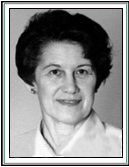 Mary Lou (Heiden) Opfermann - You might get something from
Caroline Brown
(right) too. Helma was
going to check with her. She and her husband, Bill, used to attend
all the old reunions. He used to take movies of the reunions. She is
somehow related to the Laas side. Mary Lou (Heiden) Opfermann - You might get something from
Caroline Brown
(right) too. Helma was
going to check with her. She and her husband, Bill, used to attend
all the old reunions. He used to take movies of the reunions. She is
somehow related to the Laas side.
William Frank Heiden - She was
Uncle John Laas’ daughter.
Marie (Heiden) Tommelein - She came to our place in Florida one time looking for
Helma’s address.
Ralph Heiden - Perhaps she would have the old films laying around
someplace. We could put them on videotape.
Marie (Heiden) Tommelein - I don’t remember him taking movies.
Mary Lou (Heiden) Opfermann - Oh, yes. Don’t you remember everybody trying to duck out
of the way all the time?
Helen (Henning) Heiden - You know,
Aunt
Agnes probably had some old papers.
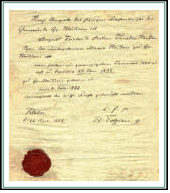 Ralph Heiden - Yes, that is where I got a lot of these old documents. They
had the names of the old villages in Germany where August and his
wife and three of their children were born. There was also a
document that I think is August’s
discharge paper from the army. He
served from 1859 to 1861. Ralph Heiden - Yes, that is where I got a lot of these old documents. They
had the names of the old villages in Germany where August and his
wife and three of their children were born. There was also a
document that I think is August’s
discharge paper from the army. He
served from 1859 to 1861.
Mildred (Roggerman) Heiden - His
naturalization papers were there too.
Ralph Heiden - Yes, the papers
where he applied for citizenship and then was granted U.S.
citizenship.
|










 Pictured
is what was called a cassette tape back in pre-digital
times.
Pictured
is what was called a cassette tape back in pre-digital
times.











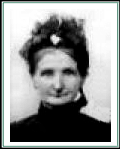 On some of the letters she adds “geb. Schmidt” after her name which
means that her maiden name was Schmidt. Well, it seems that
On some of the letters she adds “geb. Schmidt” after her name which
means that her maiden name was Schmidt. Well, it seems that



 Further
research by
Further
research by




 Over
the years, we have also received written memories and
remembrances about this person or topic from various family
members.
Over
the years, we have also received written memories and
remembrances about this person or topic from various family
members. 




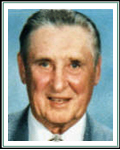
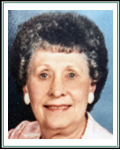
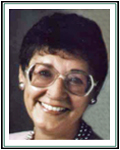
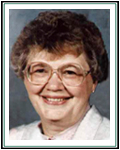
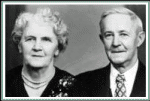 Wilma, Jeanie, Wm Frank, Helma & Marie were
children of
Wilma, Jeanie, Wm Frank, Helma & Marie were
children of