|
|
 |
|
 |
|
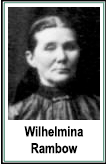 Wilma (Heiden) Bicking - I never got to know Grandma and Grandpa Heiden but
Grandma Rambow always spoke German. Wilma (Heiden) Bicking - I never got to know Grandma and Grandpa Heiden but
Grandma Rambow always spoke German.
Helma (Heiden) Nickel - I think she could speak some English but not much.
Wilma (Heiden) Bicking - She used to come and pat us on the head and give us a sugar
cookie. But that was about all.
Mildred (Roggerman) Heiden - Art used to tell that you would go to the Rambow’s house
and sit quietly on the couch all night.
Wilma (Heiden) Bicking - We had orders before we got there to behave. Take a cookie
whether you want it or not
Norma "Jeanie" Heiden - You were not to ask for anything but you would take it if
offered.
Wilma (Heiden) Bicking - She made the best white sugar cookies! She rolled them up
real thin and boy they were good! I often wonder what happened to
the recipe books she had. |
|
 |
|
|
|
|
|
|
 |
|
Ralph Heiden - What effect did the Great Depression have on the Heiden
family?
Norma "Jeanie" Heiden - It didn’t seem to impact us a lot at home on the farm.
Helma (Heiden) Nickel - When I started at River Raisin Paper Company in 1929 or 30,
I got 18 cents an hour.
 Wilma (Heiden) Bicking - I had to pay 25 cents a day for a ride to high school and
some weeks it was awfully tough to come up with that $1.25. Wilma (Heiden) Bicking - I had to pay 25 cents a day for a ride to high school and
some weeks it was awfully tough to come up with that $1.25.
Norma "Jeanie" Heiden - We didn’t have buses in those days. If you went to high
school, you had to find a ride with someone.
Wilma (Heiden) Bicking - Viola Chambers used to give me a ride. Burkes across the
river used to drive too.
Norma "Jeanie" Heiden - I had Bonnie Zorn take me to Dundee.
Mildred (Roggerman) Heiden - Art used to work for a dollar a day plus dinner during
those times.
Helma (Heiden) Nickel - Roy Salow worked for us for $30 a month.
Wilma (Heiden) Bicking - And he probably didn’t have anything to spend it on either. |
|
|
|
|
|
|
 |
|
Ralph Heiden
- What kind of activities did they have at Bridge School. Did
they have plays or recitals?
Norma "Jeanie" Heiden - I was in a play one time. I got up and said, “We will now
sing Fiddely Dee for YOU!” During practices, the teacher would
always tell me to emphasize the “you” at the end.
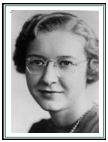 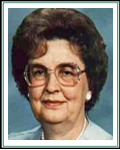 Wilma (Heiden) Bicking
(left) & Norma "Jeanie" Heiden (right) -
(start singing together) Wilma (Heiden) Bicking
(left) & Norma "Jeanie" Heiden (right) -
(start singing together)
Fiddley Dee
Fiddley Dee
The fly has married the bumble bee.
The fly to the bee
Will you marry me?
And live with me,
Sweet bumble bee.
Fiddley Dee
Fiddley Dee
Helma (Heiden) Nickel - Boy, you’re memory is still good to remember all that stuff!
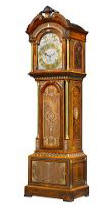 Norma "Jeanie" Heiden - And then we’d sing The Old Grandfather’s Clock. Norma "Jeanie" Heiden - And then we’d sing The Old Grandfather’s Clock.
(Everyone singing together) -
“And it stopped short,
Never to go again.
When the old man died.”
Helma (Heiden) Nickel - We had parent-teachers meetings way back then too. I
remember I was in the second grade and we all had to get up and say
a nursery rhyme. I played the part of Jack Sprat in the rhyme about
Jack Sprat could eat no fat.
That is when Leo gave me the nickname, Jack. He had a nickname for
everyone.
Mary Lou (Heiden) Opfermann - So that’s where that came from, I remember him calling
you Jack.
Norma "Jeanie" Heiden - We always had music at school. Harrison Dentel played the
piano and we had the old Golden Song Books.
Wilma (Heiden) Bicking - I still have a copy that we bought at a yard sale. We used
to sing out of that every morning at Bridge School.
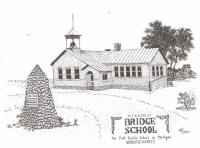 Helma (Heiden) Nickel - I have the 100th Anniversary Book for Bridge School if you
would like to see it sometime, Ralph. Helma (Heiden) Nickel - I have the 100th Anniversary Book for Bridge School if you
would like to see it sometime, Ralph.
Ralph Heiden - When you reached the end of the eighth grade, then what?
Norma "Jeanie" Heiden - People back then always thought that 8th grade was enough
schooling for anyone.
Wilma (Heiden) Bicking - You didn’t have to go on to high school in those days. I was
the first one in our family to go.
Harrison Dentel came to the house when I finished the 8th grade. He
said, “She’s only twelve years old. What is she going to do here at
home? She should go on to high school.”
Pa didn’t like the idea at all.
Mildred (Roggerman) Heiden -
Art wanted to go on to high school so bad too. But when he
was in 8th grade, they wouldn’t even let him go to Ida to take the
entrance exam.
Norma "Jeanie" Heiden - They thought going to high school was foolishness. But
finally, Harrison Dental talked and talked to them about Wilma and
they gave in.
Then, when my time came several years later, I had to beg and beg.
Pa said, “All Wilma learned up there was foolishness. Going to
parties and such foolishness.” But, they finally gave in and I got
to go.
 Wilma (Heiden) Bicking - I was in the class play my junior and senior years.
Elizabeth Johnson lived across the river and she would come to pick
me up to take me to practice. When it was time for the play, they
asked if my mother and dad were coming. I had to say, “No.” I
wouldn’t have thought about asking them. Pa would have thought that
it was really a lot of nonsense. Wilma (Heiden) Bicking - I was in the class play my junior and senior years.
Elizabeth Johnson lived across the river and she would come to pick
me up to take me to practice. When it was time for the play, they
asked if my mother and dad were coming. I had to say, “No.” I
wouldn’t have thought about asking them. Pa would have thought that
it was really a lot of nonsense.
Helma (Heiden) Nickel - Back when I would have gone, you would have had to pay
tuition to go to high school. The pastor’s kids were going to go and
I could have gone with them but I would have had to walk to the
parsonage to catch the ride every day.
Helma (Heiden) Nickel - Our road was mud at that time and we often had to walk to
the corner to get a ride somewhere. You could usually get down to
where Henry and Edna lived. When I started working at River Raisin Paper, I rode with John
Beaudrie and I had to meet him down at the corner at 6:30 every
morning. Wilma (Heiden) Bicking - I remember one Christmas Eve, everybody who came over for
the party got stuck on the road. They had to get the tractor out and
pull everybody out of the mud.
Ralph Heiden - Did you get snowed in very often back then?
Mary Lou (Heiden) Opfermann - Oh, I can remember walking down the ditches that were
full of snow.
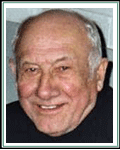 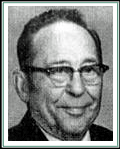 Wilma (Heiden) Bicking - We would still walk to the
Bridge School no matter how deep
the snow was then. It used to get a crust on top and it would be up
as high as the fence posts. We would walk across that and have a lot
of fun. There were always a bunch of us on the way to and from school each
day. Wilma (Heiden) Bicking - We would still walk to the
Bridge School no matter how deep
the snow was then. It used to get a crust on top and it would be up
as high as the fence posts. We would walk across that and have a lot
of fun. There were always a bunch of us on the way to and from school each
day.
There would be
Walter
(left) and
Lavern Berns,
(right) Lloyd Rath, Junior
Barnaby and Harry Karney. There would be a whole gang of us. I
remember hitting Junior Barnaby over the head with my lunch
bucket. He fell down and I thought I really hurt him but he was
O.K.
|
|
|
|
|
|
|
 |
|
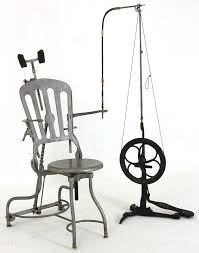 Ralph Heiden - Did any of you get to go to the dentist when you were young? Ralph Heiden - Did any of you get to go to the dentist when you were young?
Helma (Heiden) Nickel - We went to Dr. Benham in Dundee.
Mildred (Roggerman) Heiden - Boy, did we! He would be working on you and the farther
you would slouch down in the seat, the harder he’d come after you!
Wilma (Heiden) Bicking - I don’t ever remember going to the dentist when I was young.
Norma "Jeanie" Heiden - No, we didn’t go for the regular check ups or cleaning like
they do now. We went if you had a toothache and needed a tooth
pulled.
Mildred (Roggerman) Heiden - Ronnie is now going to Benham’s grandson who is a dentist
too over in Petersburg.
|
|
|
|
|
|
|
 |
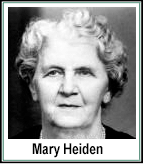 Ralph
Heiden - One of the things a lot of people have mentioned is Grandma’s
cooking. Ralph
Heiden - One of the things a lot of people have mentioned is Grandma’s
cooking.
Helma (Heiden) Nickel - At least three times a week, she would bake
bread.
Mary Lou (Heiden) Opfermann - She made the best sugar cookies!
Mildred (Roggerman) Heiden - One time
Art went
over to their house and he came back and said, “Ma’s making bread today. Don’t
you think you should go and help her?” I knew that he just wanted me to go and learn how to make bread like she did. So, I said, “With all the experience she’s had, I don’t think she needs my help!” Wilma (Heiden) Bicking - She would make donuts too. The ones I liked best where when she would make those long stick, long-johns and frost them.
Norma "Jeanie" Heiden - A lot of the relatives from Toledo like the Laas’ and Berlin’s would come on Sunday night just in time for dinner.
Mary Lou (Heiden) Opfermann - Always!
Norma "Jeanie" Heiden - They would come about 4 or 5 p.m. Ma would send us down in the basement to get some more jars of preserved beef. Boy, that made the best gravy! Or, she would make some pork sausages and fried potatoes.
Ralph Heiden - You wonder now about how people make such a big deal out of eating a pat of butter or having an occasional egg for breakfast when back then, they ate the fattest meats and sausages.
Norma "Jeanie" Heiden - Ma would save the grease from bacon. Then when you fried potatoes you would use that grease.
Wilma (Heiden) Bicking - Sometimes they would put that old lard directly onto bread and eat it like a sandwich! And we worry about eating a little bit of butter.
Mildred (Roggerman) Heiden - Art always talked about taking lard sandwiches to school.
Wilma (Heiden) Bicking - I can remember coming home from school and taking a piece of fresh bread and putting the bacon grease on it for a snack. Pa used to eat mettwurst and eggs and spicanse for breakfast. Mary Lou (Heiden) Opfermann - I can remember him cutting the fat off pork and eating it. It would make us kids almost sick.
 Norma "Jeanie" Heiden - On Easter Sunday, he would eat six boiled eggs for breakfast. That was his traditional meal. Norma "Jeanie" Heiden - On Easter Sunday, he would eat six boiled eggs for breakfast. That was his traditional meal.
Wilma (Heiden) Bicking - During Lent, we could never go to a dance or to the movies back then.
Helma (Heiden) Nickel - You never got married during Lent either. There were a lot of February weddings because you had to get married before or after Lent.
Norma "Jeanie" Heiden - Unless it was a shotgun wedding!
|
|
|
|
|
|
|
 |
|
|
|
 |
|
 William Frank Heiden - There was another
small house down the road on the east
end of the
Wakefield farm and that is where Mary Lou was born. They
had that little house for the guy who worked the farm to live in. William Frank Heiden - There was another
small house down the road on the east
end of the
Wakefield farm and that is where Mary Lou was born. They
had that little house for the guy who worked the farm to live in.
Wakefield lived where Jesse Barnes lived
(8750 Dixon Rd) and they didn’t want to
work the farm. Old man Wakefield gave me a cow on the condition that
I would give them some of the milk. I used to take over a couple of
quarts a day to them.
When Wakefield died, he gave me a gold watch and he left
Art a horse
and buggy.
Marie (Heiden) Tommelein - That was a nice watch.
William Frank Heiden - Here it is. I still have it.
Brick Tommelein - Does it run, William?
William Frank Heiden - Yes we had the movement replaced. It’s got a porcelain
dial.
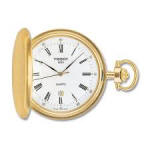 Helen (Henning) Heiden - We took it down to a jeweler to see how much it might be
worth in case somebody might break in and take it. They told us it’s
not pure gold because it wears off over time. Helen (Henning) Heiden - We took it down to a jeweler to see how much it might be
worth in case somebody might break in and take it. They told us it’s
not pure gold because it wears off over time.
William Frank Heiden - I’ve had it seventy years and I rarely carry it in my
pocket yet it’s all worn off. Old Wakefield must have carried it for
a long time before he died.
Brick Tommelein - Some of those old railroad watches used to be worth
something.
Ralph Heiden - Why did Mr. Wakefield leave things to you boys?
William Frank Heiden - Well, we always waited on him and did things for him all
the time.
Brick Tommelein - Mil, was that when
Art started courting you when he had that
buggy?
Mildred (Roggerman) Heiden - No, he had an old Model T Ford by the time we starting
going out.
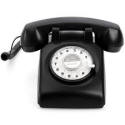 Marie (Heiden) Tommelein - Remember we used to play tricks on old Wakefield? It was
after we got a telephone. When Ma and Pa would be gone, we would
watch to see when he was outside and then we’d call him up. As soon
as he got in the house, we’d hang up. Later he would tell Pa,
“Somebody kept calling me all day today. By the time I got there,
they’d hang up!” Marie (Heiden) Tommelein - Remember we used to play tricks on old Wakefield? It was
after we got a telephone. When Ma and Pa would be gone, we would
watch to see when he was outside and then we’d call him up. As soon
as he got in the house, we’d hang up. Later he would tell Pa,
“Somebody kept calling me all day today. By the time I got there,
they’d hang up!”
Ralph Heiden - I didn’t think you guys did that kind of stuff.
(laughs)
Marie (Heiden) Tommelein - Oh, yes we did but Pa never knew it.
|
|
|
|
|
|
|
 |
|
William Frank Heiden - We used to go sparrow hunting with him
(Billy Miller) back when there was
a bounty on sparrows. He used to put the dead sparrows in his
pockets and he’d go to divide them up and we’d sneak into his other
pocket and take one out while he wasn’t looking.
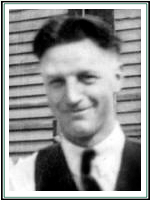 Marie (Heiden) Tommelein - I used to hold the flashlight for
Art and
Heinie Heiden
(right) when
they would go after sparrows at night. They got 2 cents a piece and
I never got anything! Marie (Heiden) Tommelein - I used to hold the flashlight for
Art and
Heinie Heiden
(right) when
they would go after sparrows at night. They got 2 cents a piece and
I never got anything!
William Frank Heiden - I used to go into that house a lot of times. There was a
barn across the road on the south side. They had a corn crib and
chicken coop on the north side where the house was.
The red garage out in our drive came from that house when they tore
it down. The beams and things came from that old house.
|
|
 |
|
 English
sparrows are a non-native species and in 1887
Michigan paid a bounty of 1 cent per dead bird
brought to the county clerk's office. I was unaware
of it as a boy growing up in the 1950s and 60s but
technically, the law was still in effect until
repealed in 2000. English
sparrows are a non-native species and in 1887
Michigan paid a bounty of 1 cent per dead bird
brought to the county clerk's office. I was unaware
of it as a boy growing up in the 1950s and 60s but
technically, the law was still in effect until
repealed in 2000. |
|
|
|
|
|
|
 |
|
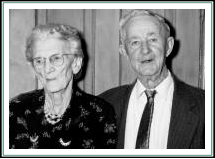 Ralph Heiden - I asked people to write down a little remembrance of
Grandpa
and Grandma and those have turned out to be really nice. Ralph Heiden - I asked people to write down a little remembrance of
Grandpa
and Grandma and those have turned out to be really nice.
Brick Tommelein - Here, one of our kids says that Grandpa used to reward him
with a little sip of beer.
Marie (Heiden) Tommelein - Pa always knew all of his grandchildren by name. When you
think of it, that was amazing since he had so many of them.
William Frank Heiden - And it’s not like today when your grandchildren are spread
all over and you don’t get to see them very often. Back then, they
got to see them all the time.
It’s hard sometimes to keep track of them especially with the names
they come up with now. You don’t see many Johns or Bills.
Marie (Heiden) Tommelein - Tell me about it!
Mildred (Roggerman) Heiden - My grandchildren go from A to Z.
Adam to
Zachary.
Helen (Henning) Heiden - Tom and Janice’s last grandchild is named
Peyton.
Marie (Heiden) Tommelein - Our neighbor’s have a little girl they named Montgomery
Alicia! That poor kid when she goes to school. She has a long life
ahead of her.
|
|
|
|
|
|
|
|
 |
|
|
 Over
the years, we have also received written memories and
remembrances about this person or topic from various family
members. Over
the years, we have also received written memories and
remembrances about this person or topic from various family
members. |
|
 |
 |
|
| |
|
| |
|
| |
|
|
|
|
|
|
 |
|
 |
|








 Pictured
is what was called a cassette tape back in pre-digital
times.
Pictured
is what was called a cassette tape back in pre-digital
times.









 Ralph Heiden - That was the way they used to do it. Often the person was
named after the people who stood up for them at baptism. If they had
four witnesses, they had four names.
Ralph Heiden - That was the way they used to do it. Often the person was
named after the people who stood up for them at baptism. If they had
four witnesses, they had four names. I'm
glad they stopped using this system
sometime before I was born or my
name would have been Mary Lou after
my godmother, Mary Lou Opfermann.
I'm
glad they stopped using this system
sometime before I was born or my
name would have been Mary Lou after
my godmother, Mary Lou Opfermann. 
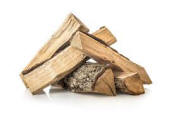 Wilma (Heiden) Bicking - I had to fill the woodbox with firewood for the stove in the
kitchen.
Wilma (Heiden) Bicking - I had to fill the woodbox with firewood for the stove in the
kitchen. 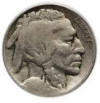 Norma "Jeanie" Heiden - We thought 5 cents a row was going to be a lot but the rows
ran all the way back to the woods. You got to the end and you would
say to yourself, “Ugh, there’s another 5 cents.” You would make
about 15 or 20 cents a day at that rate!
Norma "Jeanie" Heiden - We thought 5 cents a row was going to be a lot but the rows
ran all the way back to the woods. You got to the end and you would
say to yourself, “Ugh, there’s another 5 cents.” You would make
about 15 or 20 cents a day at that rate!




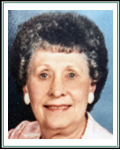
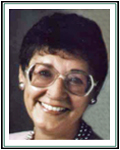
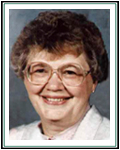
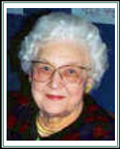
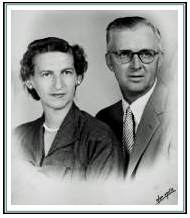
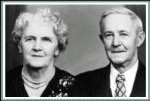 Wilma, Jeanie, Wm Frank, Helma & Marie were
children of
Wilma, Jeanie, Wm Frank, Helma & Marie were
children of