|
|
 |
|
Ralph Heiden - What kind of farm did Grandma and Grandpa (William Carl and Mary Heiden) have while you
were growing up?
Norma "Jeanie" Heiden - We raised pigs to butcher.
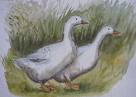 Helma (Heiden) Nickel - Ma raised geese. She made us all a feather bed from the
down. Helma (Heiden) Nickel - Ma raised geese. She made us all a feather bed from the
down.
Wilma (Heiden) Bicking - I got flogged by a goose once. Believe me, they could hurt
you!
Helma (Heiden) Nickel - Aunts and Uncles would get together pull out the down and
put them in bags and dry them for mattresses. Feather beds.
Norma "Jeanie" Heiden - Remember how we used to be afraid to get the eggs out from
under the old setting hens? They’d pick you on the hands if you
reached in for the eggs.
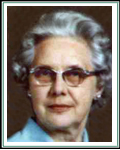
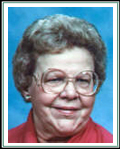 Pat (Bicking) Klass - We would throw corncobs at them to get them off the nest. Aunt Helen (right) would say, “What’s the matter with you?” and reach in and pull
them out with her hand. Pat (Bicking) Klass - We would throw corncobs at them to get them off the nest. Aunt Helen (right) would say, “What’s the matter with you?” and reach in and pull
them out with her hand.
Helma (Heiden) Nickel - We would take a stick and hold their head down and then
reach in to take the eggs from the nest.
Norma "Jeanie" Heiden - They were old setting hens and they did not want to get off
the nest. There were always a few that just wouldn’t get off the
nest for you.
Pat (Bicking) Klass - We would beg Helen to let us help get the eggs. Then the next
day, she would wonder what all those corncobs were doing in the
nests.
 Norma "Jeanie" Heiden - You always had a nasty rooster out there too that would come
after you. You’d be scared stiff.
I remember Ma would kill the chickens. She hold them down and take
the ax and cut off the heads and then dunk them in hot water. Then
she’d pick the feathers off them and we’d have to pull out those
darn pinfeathers. She’d cut them all up and soak them in some sort of saltwater over
night. The next morning, boy, that would make the best chicken! They
don’t taste like that now. Norma "Jeanie" Heiden - You always had a nasty rooster out there too that would come
after you. You’d be scared stiff.
I remember Ma would kill the chickens. She hold them down and take
the ax and cut off the heads and then dunk them in hot water. Then
she’d pick the feathers off them and we’d have to pull out those
darn pinfeathers. She’d cut them all up and soak them in some sort of saltwater over
night. The next morning, boy, that would make the best chicken! They
don’t taste like that now.
Mary Lou (Heiden) Opfermann - My dad (Leo
Heiden) used to cut the heads off like that on Saturday.
Then he’d let them run around and us kids would laugh. Then he’d dip
them in hot water and come in and dump them on the table. That was
the end of his part. It was Mother’s job from then on.
Wilma (Heiden) Bicking - When we first got married, Bill noticed that William and
Helen always had chickens in the freezer. He said, “Why don’t we put
some chickens in our freezer too?”
I said, “Oh, I don’t know about that.”
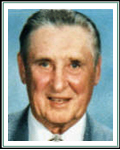 William (Wm Frank right) asked Bill, “You want some chickens? Come on out next week.
I’ve got some and you can have them.” William (Wm Frank right) asked Bill, “You want some chickens? Come on out next week.
I’ve got some and you can have them.”
So we went out there. William started to cut off the heads and stuck
them into a sleeve thing that held them while they bled out. And the
chickens were bleeding and squirming around.
Before long, William turned around and said, “Where’s Bill?”
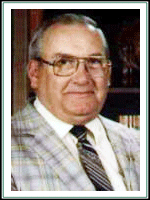 Bill (Bicking left) had disappeared around the corner of the shed. We went around
to find him and he said, “My God, I’ll never eat another chicken in
my life!” Bill (Bicking left) had disappeared around the corner of the shed. We went around
to find him and he said, “My God, I’ll never eat another chicken in
my life!”
He never talked about putting chickens in the freezer after that. Norma "Jeanie" Heiden - That’s the city kid in him.
Mary Lou (Heiden) Opfermann - That smell when you put them in the hot water was enough
to put anyone off chicken.
Helma (Heiden) Nickel - Talking about chickens. They have those Amish chickens every
once in a while at the store and they taste like real chickens like
we used to have on the farm.
Mary Lou (Heiden) Opfermann - I bet they’re corn fed. And they let them run in the
field too.
Helma (Heiden) Nickel - I haven’t been able to find them since. They don’t have any
chemicals and stuff fed to them.
Pat (Bicking) Klass - It’s amazing we eat anything anymore.
Wilma (Heiden) Bicking - Ma would take the chickens in the house and light a rolled
up newspaper and singe off the remaining feathers.
Norma "Jeanie" Heiden - We had guinea hens too.
Helma (Heiden) Nickel - They were like watchdogs. They would start to “holler” and
make loud noises that would chase animals away.
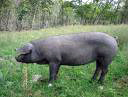 Norma "Jeanie" Heiden - The best time was when Pa would kill a pig. We would have
fresh liver that night. Boy that was fresh and delicious! They would
slice it real thin and they would make that dark, black gravy. Wilma
never liked it but I loved that dark gravy! Norma "Jeanie" Heiden - The best time was when Pa would kill a pig. We would have
fresh liver that night. Boy that was fresh and delicious! They would
slice it real thin and they would make that dark, black gravy. Wilma
never liked it but I loved that dark gravy!
I tried buying liver at Baisley’s and I brought it home but it was
nothing like what we used to have when we lived on the farm. Wilma (Heiden) Bicking - I would just hate it when I knew they were going to butcher
because I would come home and they would have liver for supper.
That is the only time I can remember that Ma bent her rules.
Normally, we were expected to eat whatever was put on the table.
But, I hated liver so much and almost got sick so finally she said,
“Oh, all right, I’ll fry you an egg and don’t act so foolish.” Mildred (Roggerman) Heiden - Art used to talk about catching the blood from the pigs as
they butchered them. They would make blood cheese and sausage.
Helma (Heiden) Nickel - That was something I could never eat. I don’t remember them
making it very much.
Wilma (Heiden) Bicking - We were talking the other day about “souse” (spelling?) and
head cheese and those things.
Norma "Jeanie" Heiden - They also made that apple stuff with the cracklings and
things when they butchered.
Helma (Heiden) Nickel - That was from frying out the lard. They mixed that with
apples.
 Norma "Jeanie" Heiden - Pa always made the mettwurst out in the smokehouse. Norma "Jeanie" Heiden - Pa always made the mettwurst out in the smokehouse.
Wilma (Heiden) Bicking - Boy, that is one thing that you cannot buy. Not that tastes
like that did. Carl was the last one who could make it taste like
that.
Norma "Jeanie" Heiden - Remember all the wine and cider barrels in the basement?
They’d tell us to go down and siphon off some of the wine with a
hose once in a while.
Mary Lou (Heiden) Opfermann - I can still smell that wine down there. Remember when we
got drunk that time?
Norma "Jeanie" Heiden - We siphoned off too much. They were playing cards and they
told us to go down and get a pitcher of wine. We would just empty
off all the glasses before refilling them. Pretty soon we were.
Mary Lou (Heiden) Opfermann - Remember how mad they got?
Ralph Heiden - Was everything you used at home mostly homemade?
Norma "Jeanie" Heiden - Everything. I don’t ever remember buying any canned goods
back then.
Helma (Heiden) Nickel - We used to have a grocery wagon come by every Monday. A guy
named Jake Myers traveled around from his store in Strasburg (Michigan).
Wilma (Heiden) Bicking - He had a big truck that he would drive around the
countryside selling his goods.
Helma (Heiden) Nickel - Ma would go out to the road when he would come by with a
basket of eggs and trade them for groceries.
Norma "Jeanie" Heiden - I remember peaking over the edge of the truck and looking at
the box of candies. I don’t know what you would get for a basket of
eggs. Maybe some summer sausage. Ma and Pa would go to town, to Monroe, once in a while and come home
with link balogneys in buns with mustard on them.
Helma (Heiden) Nickel - That would be our Saturday night supper.
Mildred (Roggerman) Heiden - Art used to say, “Give me a tase of one of them der buns.”
Wilma (Heiden) Bicking - Pa went to the mill with the wheat to get flour.
Helma (Heiden) Nickel - He would trade bags of wheat for bags of flour.
Norma "Jeanie" Heiden - Then he went to Heck’s Market right across the street.
Helma (Heiden) Nickel - I think it’s Schroeder’s now.
Norma "Jeanie" Heiden - Pa would also buy peanuts. Peanuts in the shell which he
just loved.
Mary Lou (Heiden) Opfermann - That must be where my Dad (Leo Heiden) got his love for peanuts in the
shell too. |
|
 |
|
|
|
|
 |
|
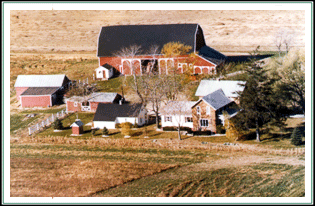 Mary Lou (Heiden) Opfermann - You say they bought the
house in 1909? I thought
Great Grandpa built the house. Mary Lou (Heiden) Opfermann - You say they bought the
house in 1909? I thought
Great Grandpa built the house.
Norma "Jeanie" Heiden -
Pa bought the place from
Meyers.
Wilma (Heiden) Bicking - Stella Graf’s grandma and
grandma built that house.
Norma "Jeanie" Heiden - I forget what Pa said they
had to pay for the farm. I think it was about $75 per acre or
something. It was 140 acres.
Helma (Heiden) Nickel - It is 141 acres. They always
had to go down to Stella’s folks, the Langs, to pay the mortgage
payments.
Norma "Jeanie" Heiden - They must have bought it on
land contract then or they wouldn’t have had to pay the Langs.
Afterwards, they got a loan from Monroe County Bank. I was still
in high school when they finally paid it off. That would have
been in the early 1940's, maybe 1941 or so.
Sometimes they would have to
borrow money to pay the taxes. Fortunately, Gilbert Oyer at the
bank knew all those farmers and he knew they were good for it.
He’d loan them the money for the taxes but then they would not
be getting any of the principal down on the loan that year.
Ralph Heiden - I have some
old property tax receipts that my great grandfather,
August Heiden, paid from the late 1800's to about 1911.
Mary Lou (Heiden) Opfermann - Where did they live
then?
Helma (Heiden) Nickel - Over on
South Custer where
Uncle John and Aunt Agnes
(Brockman) Heiden
lived.
Ralph Heiden - The property tax form says that
August Heiden's
property on South Custer Road was bordered on the north by Jacob
Mathis, on the east by George Rath and William D. Miller, and on
the west by
Ernst "Ernest" Heiden. In some of the older
receipts, it says they were bordered on the north by W. Stock,
on east by C. Rath and on the west by K. Opfermann.
Norma "Jeanie" Heiden - K. Opfermann?
Helma (Heiden) Nickel - Killian Opfermann would be
Frank’s dad.
Wilma (Heiden) Bicking - Did William and Helen
ever have a survey done on the home farm?
Ralph Heiden - Yes, they wrote in their letter that
they have a copy of the title search.
Norma "Jeanie" Heiden - That’s what I do for a
living. I’ve been doing it since April 3, 1946 and worked until
April 30, 1989. Now I work part-time at it.
Wilma (Heiden) Bicking - We’ll have to have a big
party next year to celebrate Jeanie working 50 years.
|
|
|
|
|
 |
|
|
|
 |
|
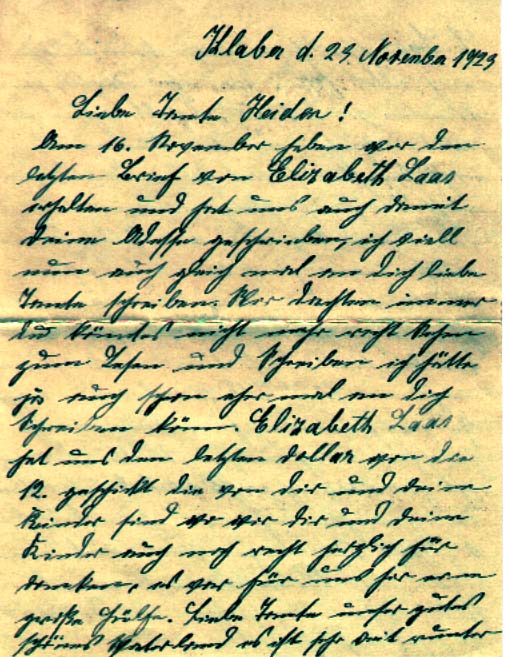
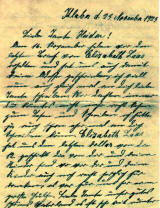 Ralph Heiden - The letters are rather sad overall. They were having some
very tough times in Germany then and they were always asking their
Aunt Rika, my great grandmother, for money. Ralph Heiden - The letters are rather sad overall. They were having some
very tough times in Germany then and they were always asking their
Aunt Rika, my great grandmother, for money.
Mildred (Roggerman) Heiden - In one of them, they ask for some money for a house and
some land. Then, later they say they bought the house but needed
more money for the land.
Marie (Heiden) Tommelein - Did they ever help them?
Ralph Heiden - Yes, they sent money when they could and they were always
very appreciative of it and told what the money would buy.
Brick Tommelein - My dad said that at that time, everyone over in Europe
called America “the land of opportunity.”
Ralph Heiden - A lot of people here were helping their relatives then too.
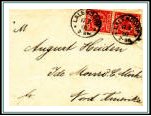
In one of the letters, they ask Rika to send her letters registered
because people were stealing things from mail from America because
those envelopes were likely to have money in them.
Helen (Henning) Heiden - Now are these letters all from
Mecklenburg?
Ralph Heiden - Yes. They are from the area called Mecklenburg and the port
city of Rostock. The little villages where our ancestors came from
are the size of
Grape and Maybee and they are about 50 miles from
Rostock.
 Helen (Henning) Heiden - From the Hennings, I heard them say that the people were
like slaves back then in Germany. They worked for all these big rich
people. They provided pay for them and took care of them but they
couldn’t get ahead. They didn’t want them to get married because
there were already too many of them to take care of. That is where
the Hennings came from too. Helen (Henning) Heiden - From the Hennings, I heard them say that the people were
like slaves back then in Germany. They worked for all these big rich
people. They provided pay for them and took care of them but they
couldn’t get ahead. They didn’t want them to get married because
there were already too many of them to take care of. That is where
the Hennings came from too.
Mildred (Roggerman) Heiden - Didn’t you say that our name should be something other
than Heiden?
Ralph Heiden - Yes, my great grandmother,
Maria Heiden, did not marry the
father of August. So, he took her name rather than his father’s
which was
Kanseyer
or Canseyer.
Helen (Henning) Heiden - That’s the same way with my grandpa Henning. Grandma wasn’t
married when she had those two kids.
Ralph Heiden - That was a real common occurrence back then.
Mildred (Roggerman) Heiden - They wouldn’t let you get married unless you could support
yourself.
Ralph Heiden - They technically weren’t slaves but there was nowhere else
for them to go except to another big estate to work and they were
full too. Also, the landowner had the responsibility to take care of
the people on his land so he was stuck too.
That is why they pushed a lot of them to leave and go to America.
Also, the illegitimacy rate went way up because even though they
weren’t legally allowed to marry, people continued to form couples
and do what they needed to do.
Helen (Henning) Heiden - You wonder why the Heidens would come here but they said on
the Henning side that they would send money back to Germany to help
others come here.
Ralph Heiden - But with the Heidens, we don’t know who was here to pave the
way for them. Maybe with this Laas connection, there might be
something to go on.
The
Rambows came a year later. They came here in 1874 and I don’t
know if they came from the same part of Germany as the Heidens. I
haven’t looked into that yet. (See the note below)
I think about the only way we are going to learn why the Heidens
came here is if we stumble onto somebody in one of the other
branches that has an old box of papers up in the attic that someone
gave them long ago. Otherwise, the reason may be lost to history.
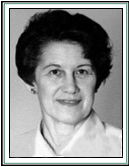 Mary Lou (Heiden) Opfermann - You might get something from
Caroline Brown
(right) too. Helma was
going to check with her. She and her husband, Bill, used to attend
all the old reunions. He used to take movies of the reunions. She is
somehow related to the Laas side. Mary Lou (Heiden) Opfermann - You might get something from
Caroline Brown
(right) too. Helma was
going to check with her. She and her husband, Bill, used to attend
all the old reunions. He used to take movies of the reunions. She is
somehow related to the Laas side.
William Frank Heiden - She was
Uncle John Laas’ daughter.
Marie (Heiden) Tommelein - She came to our place in Florida one time looking for
Helma’s address.
Ralph Heiden - Perhaps she would have the old films laying around
someplace. We could put them on videotape.
Marie (Heiden) Tommelein - I don’t remember him taking movies.
Mary Lou (Heiden) Opfermann - Oh, yes. Don’t you remember everybody trying to duck out
of the way all the time?
Helen (Henning) Heiden - You know,
Aunt
Agnes probably had some old papers.
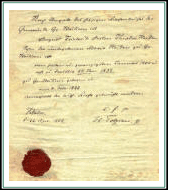 Ralph Heiden - Yes, that is where I got a lot of these old documents. They
had the names of the old villages in Germany where August and his
wife and three of their children were born. There was also a
document that I think is August’s
discharge paper from the army. He
served from 1859 to 1861. Ralph Heiden - Yes, that is where I got a lot of these old documents. They
had the names of the old villages in Germany where August and his
wife and three of their children were born. There was also a
document that I think is August’s
discharge paper from the army. He
served from 1859 to 1861.
Mildred (Roggerman) Heiden - His
naturalization papers were there too.
Ralph Heiden - Yes, the papers
where he applied for citizenship and then was granted U.S.
citizenship.
|
|
 Further
research by
Karen (Berns) Wheaton
and myself found that the Rambows and Heidens lived
in the same little village of
Gross Wokern, Germany. Caroline Brown's maiden
name was Laas. Further
research by
Karen (Berns) Wheaton
and myself found that the Rambows and Heidens lived
in the same little village of
Gross Wokern, Germany. Caroline Brown's maiden
name was Laas. |
|
|
|
|
|
|
|
|
 |
|
 William Frank Heiden - There was another
small house down the road on the east
end of the
Wakefield farm and that is where Mary Lou was born. They
had that little house for the guy who worked the farm to live in. William Frank Heiden - There was another
small house down the road on the east
end of the
Wakefield farm and that is where Mary Lou was born. They
had that little house for the guy who worked the farm to live in.
Wakefield lived where Jesse Barnes lived
(8750 Dixon Rd) and they didn’t want to
work the farm. Old man Wakefield gave me a cow on the condition that
I would give them some of the milk. I used to take over a couple of
quarts a day to them.
When Wakefield died, he gave me a gold watch and he left
Art a horse
and buggy.
Marie (Heiden) Tommelein - That was a nice watch.
William Frank Heiden - Here it is. I still have it.
Brick Tommelein - Does it run, William?
William Frank Heiden - Yes we had the movement replaced. It’s got a porcelain
dial.
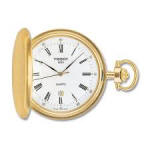 Helen (Henning) Heiden - We took it down to a jeweler to see how much it might be
worth in case somebody might break in and take it. They told us it’s
not pure gold because it wears off over time. Helen (Henning) Heiden - We took it down to a jeweler to see how much it might be
worth in case somebody might break in and take it. They told us it’s
not pure gold because it wears off over time.
William Frank Heiden - I’ve had it seventy years and I rarely carry it in my
pocket yet it’s all worn off. Old Wakefield must have carried it for
a long time before he died.
Brick Tommelein - Some of those old railroad watches used to be worth
something.
Ralph Heiden - Why did Mr. Wakefield leave things to you boys?
William Frank Heiden - Well, we always waited on him and did things for him all
the time.
Brick Tommelein - Mil, was that when
Art started courting you when he had that
buggy?
Mildred (Roggerman) Heiden - No, he had an old Model T Ford by the time we starting
going out.
 Marie (Heiden) Tommelein - Remember we used to play tricks on old Wakefield? It was
after we got a telephone. When Ma and Pa would be gone, we would
watch to see when he was outside and then we’d call him up. As soon
as he got in the house, we’d hang up. Later he would tell Pa,
“Somebody kept calling me all day today. By the time I got there,
they’d hang up!” Marie (Heiden) Tommelein - Remember we used to play tricks on old Wakefield? It was
after we got a telephone. When Ma and Pa would be gone, we would
watch to see when he was outside and then we’d call him up. As soon
as he got in the house, we’d hang up. Later he would tell Pa,
“Somebody kept calling me all day today. By the time I got there,
they’d hang up!”
Ralph Heiden - I didn’t think you guys did that kind of stuff.
(laughs)
Marie (Heiden) Tommelein - Oh, yes we did but Pa never knew it.
|
|
|
|
|
|
|
 |
|
William Frank Heiden - We used to go sparrow hunting with him
(Billy Miller) back when there was
a bounty on sparrows. He used to put the dead sparrows in his
pockets and he’d go to divide them up and we’d sneak into his other
pocket and take one out while he wasn’t looking.
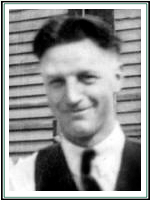 Marie (Heiden) Tommelein - I used to hold the flashlight for
Art and
Heinie Heiden
(right) when
they would go after sparrows at night. They got 2 cents a piece and
I never got anything! Marie (Heiden) Tommelein - I used to hold the flashlight for
Art and
Heinie Heiden
(right) when
they would go after sparrows at night. They got 2 cents a piece and
I never got anything!
William Frank Heiden - I used to go into that house a lot of times. There was a
barn across the road on the south side. They had a corn crib and
chicken coop on the north side where the house was.
The red garage out in our drive came from that house when they tore
it down. The beams and things came from that old house.
|
|
 |
|
English
sparrows are a non-native species and in 1887
Michigan paid a bounty of 1 cent per dead bird
brought to the county clerk's office. I was unaware
of it as a boy growing up in the 1950s and 60s but
technically, the law was still in effect until
repealed in 2000. |
|
|
|
|
|
|
 |
|
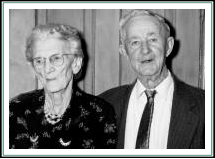 Ralph Heiden - I asked people to write down a little remembrance of
Grandpa
and Grandma and those have turned out to be really nice. Ralph Heiden - I asked people to write down a little remembrance of
Grandpa
and Grandma and those have turned out to be really nice.
Brick Tommelein - Here, one of our kids says that Grandpa used to reward him
with a little sip of beer.
Marie (Heiden) Tommelein - Pa always knew all of his grandchildren by name. When you
think of it, that was amazing since he had so many of them.
William Frank Heiden - And it’s not like today when your grandchildren are spread
all over and you don’t get to see them very often. Back then, they
got to see them all the time.
It’s hard sometimes to keep track of them especially with the names
they come up with now. You don’t see many Johns or Bills.
Marie (Heiden) Tommelein - Tell me about it!
Mildred (Roggerman) Heiden - My grandchildren go from A to Z.
Adam to
Zachary.
Helen (Henning) Heiden - Tom and Janice’s last grandchild is named
Peyton.
Marie (Heiden) Tommelein - Our neighbor’s have a little girl they named Montgomery
Alicia! That poor kid when she goes to school. She has a long life
ahead of her.
|
|
|
|
See
the entire contents of the
Written Rembrances section. |
|
|
|
| |
|
|
 |
|
|
 Over
the years, we have also received written memories and
remembrances about this person or topic from various family
members. Over
the years, we have also received written memories and
remembrances about this person or topic from various family
members. |
|
 |
 |
|
| |
|
| |
|
| |
|
|
|
|
|
|
 |
|
 |
|








 Pictured
is what was called a cassette tape back in pre-digital
times.
Pictured
is what was called a cassette tape back in pre-digital
times.








 Ralph Heiden - What do you two (




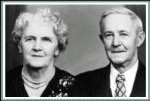 Wilma, Jeanie, Wm Frank, Helma & Marie were
children of
Wilma, Jeanie, Wm Frank, Helma & Marie were
children of