|
 |
|
|
|
 |
|
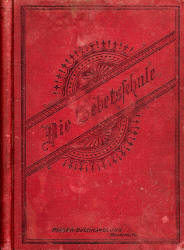 Helma (Heiden) Nickel - Here is a book that the preacher must have given Ma and Pa
on the day they were married. It is all in German and that is all
that I could make of it. That would have been in 1897 when they were
married. It really should be with the Heiden History. Helma (Heiden) Nickel - Here is a book that the preacher must have given Ma and Pa
on the day they were married. It is all in German and that is all
that I could make of it. That would have been in 1897 when they were
married. It really should be with the Heiden History.
 (The inside panel of the book reads:
Die Gebetsschule oder Die Herzen in die Hoehe! Das Gebet im
allgemeinen und das Vaterunser im besonderen erklaert durch
Gedanken, Sinnbilder und Dergleichen.
Sonntagsschulen und der Familie dargeboten. (The inside panel of the book reads:
Die Gebetsschule oder Die Herzen in die Hoehe! Das Gebet im
allgemeinen und das Vaterunser im besonderen erklaert durch
Gedanken, Sinnbilder und Dergleichen.
Sonntagsschulen und der Familie dargeboten.
This translates into:
“The school of prayers or High up the hearts! The prayer in general
and the Lord's prayer especially explained through thoughts and
allegories. Presented to Sunday Schools and to the family.”)
Norma "Jeanie" Heiden - Can you understand German, Ralph?
 Ralph Heiden - A little bit. I have been getting help on translations from
the Prodigy computer network. Let’s start through some of this stuff
that I have accumulated over the years. It was very fortunate that
in about 1971 my mother and I went over to visit Aunt Agnes (William Carl Heiden’s sister-in-law
and wife of John Heiden). I asked, “Do you
have any old papers or anything?” Ralph Heiden - A little bit. I have been getting help on translations from
the Prodigy computer network. Let’s start through some of this stuff
that I have accumulated over the years. It was very fortunate that
in about 1971 my mother and I went over to visit Aunt Agnes (William Carl Heiden’s sister-in-law
and wife of John Heiden). I asked, “Do you
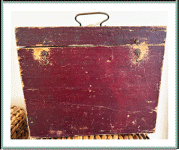
have any old papers or anything?” Well, she went up in the closet and got this old box with these old
documents. It has August Heiden's naturalization papers when he
became a U.S. citizen. There were some
old letters from Germany.
In the early 70's, I sent to the East German government requesting
information and that is where I got a good start on the Heiden’s in
Germany.
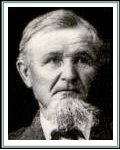 Here is a document where my great-grandfather, August
(right), applied for
U.S. citizenship. He had to renounce all allegiance to the Emperor
of Germany. Here is a document where my great-grandfather, August
(right), applied for
U.S. citizenship. He had to renounce all allegiance to the Emperor
of Germany.
I have maps of the tiny little towns in what was East Germany where
all our ancestors came from. They were sort of like Maybee and Ida
and Grape. Very small little places only a few miles apart. Norma "Jeanie" Heiden - What about High German and Low German?
Ralph Heiden - I don’t know much about it but I think it is just different
ways of speaking the language similar to Irish English versus
British English versus American English.
|
 |
|
 "Low German, also known as Plattdeutsch, is spoken
in the northern, flatlands of Germany, while High German
dialects are found in the southern and central regions,
including the mountainous areas." "Low German, also known as Plattdeutsch, is spoken
in the northern, flatlands of Germany, while High German
dialects are found in the southern and central regions,
including the mountainous areas."
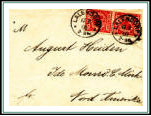
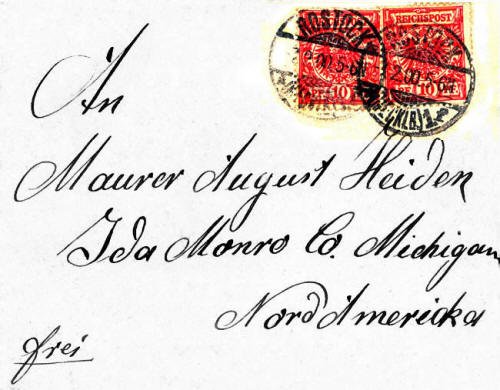
One of the envelopes
from the 1920s letters from Germany is shown below. It seems a
miracle that it was actually delivered to the correct person. |
 |
 Maurer
in German means bricklayer which was the
trade August learned in Germany. Maurer
in German means bricklayer which was the
trade August learned in Germany. |
|
|
 |
|
|
|
|
 |
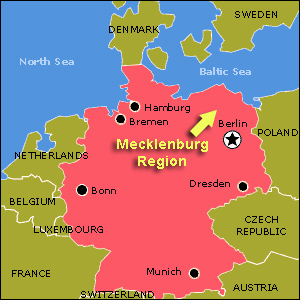 Wilma (Heiden) Bicking - Pa always said they came from
Mecklenburg. Is that a county
or what? When we were in Germany we saw a sign for town called Heidenfahrt! Wilma (Heiden) Bicking - Pa always said they came from
Mecklenburg. Is that a county
or what? When we were in Germany we saw a sign for town called Heidenfahrt!
Ralph Heiden - Mecklenburg is a region of Germany. The Heidens came from
tiny little towns called
Gross Wokern,
Mamerow,
Klaber and a bunch
of others.
Now, where did your grandfather, August, live here in Monroe County? Helma (Heiden) Nickel - August always lived on
South Custer where
Uncle John lived.
That’s the only place they lived as far as I know. The same with the Rambows. [See Note Below]
|
|
|
|
Later research showed that August Heiden and family lived on
West 9th Street in the City of Monroe according to the 1880 U.S. Census. We don't know exactly when the bought the property on South Custer Road. The 1890 census reports were destroyed by a fire.
I also
saw the town of
Heidenfahrt on a map of
Germany. It translates into
Heathen Journey or a
journey to a heath. |
 |
|
|
|
|
|
|
 |
Wilma (Heiden) Bicking - I have an old family picture that has a lot of other people
who we cannot identify. Perhaps they are the
Rambow branch?
 Norma "Jeanie" Heiden - They may have lived in Dundee for a while because Ma got
confirmed in the church in Dundee, I think. But maybe the preacher from Dundee came down here to do the confirmations. [See Note Below] Norma "Jeanie" Heiden - They may have lived in Dundee for a while because Ma got
confirmed in the church in Dundee, I think. But maybe the preacher from Dundee came down here to do the confirmations. [See Note Below]
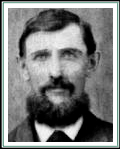
Helma (Heiden) Nickel - I remember when
Grandpa
(Heinrich) Rambow (left) died, they were living down
there on
South Custer Rd. Across from where
Lester lived. I was only
about 8 years old when that happened.
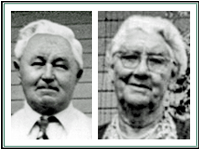 Jeanie & Helma (Heiden) Nickel - Remember when
Uncle Herman married
Aunt Reka and Pa
married Mary. Brothers married two sisters.
Uncle John started going
with Aunt Minnie and Grandma Rambow said, “That’s enough of those
Heidens!” Jeanie & Helma (Heiden) Nickel - Remember when
Uncle Herman married
Aunt Reka and Pa
married Mary. Brothers married two sisters.
Uncle John started going
with Aunt Minnie and Grandma Rambow said, “That’s enough of those
Heidens!”
Wilma (Heiden) Bicking - Perhaps Aunt Minnie would have been a different person if
she had married Uncle John.
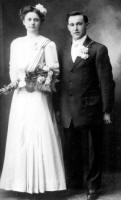 Helma (Heiden) Nickel
-
Uncle John couldn’t have got any better wife than he did
with Aunt Agnes. Helma (Heiden) Nickel
-
Uncle John couldn’t have got any better wife than he did
with Aunt Agnes.
Wilma (Heiden) Bicking - He used to make cherry pit wine.
Helma (Heiden) Nickel - He would make it out of pits and some cherries too.
Wilma (Heiden) Bicking - It was potent stuff!
Wilma (Heiden) Bicking - At one time, I had August’s “thunder mug” but I don’t have
it anymore. The ceramic was kind of checked in the bottom and it was
very well used. I often wondered how they got down to use it since
it was so low to the ground.
|
|
|
|
William and
Minnie Rambow
were unmarried brother and sister who lived together on the
family farm on South Custer Rd their entire lives.
Also, according to the 1880 U.S. Census, Heinrich and Wilhelmina
(Milhan) Rambow were living in Dundee Township with children,
Friedrich "Fred",
Bertha (Burgard),
Henry III and
Mary (Heiden). Their third daughter,
Fredareka (Heiden) was born in 1880 probably after the date
of the census and
William was born in 1882 followed by
Miss Minnie in 1886. We do not know exactly when they moved
to the farm on South Custer but it shows at least that Henry III
and Mary were born in Dundee Township. Fred and Bertha
were born in Germany. |
|
|
|
|
|
|
 |
|
 |
Ralph Heiden - Did Grandma and Grandpa (William Carl and Mary) do much with their
brothers and sisters?
 Helma (Heiden) Nickel -
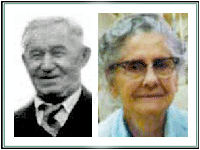
Uncle John and Aunt Agnes
(left) and them did a lot together. Agnes
was a big help to Ma. They would do a lot of sewing together. Helma (Heiden) Nickel -
Uncle John and Aunt Agnes
(left) and them did a lot together. Agnes
was a big help to Ma. They would do a lot of sewing together.
Wilma (Heiden) Bicking - They would cut down coats
from the older ones so they would fit
the younger ones in the family.
Helma (Heiden) Nickel -
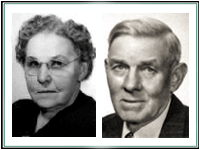
Uncle John Kosters
(right) would come down a lot too. They would go
to church and then come over to the house for dinner.
Ralph Heiden - Did they speak German to each other?
Wilma (Heiden) Bicking - Sometimes when they were saying something they did not want
the kids to hear! Then they would laugh loudly, “Ha, ha, ha!.” We
always wondered what they had said.
Helma (Heiden) Nickel - They did not go back and forth too much with
Uncle
Ernest and Aunt Annie. I don’t remember Uncle Ernest’s family coming
to church very often either.
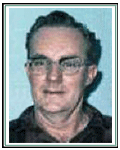 Mildred (Roggerman) Heiden - Someone who would remember would be
Marv Koster
(left). He
remembers a lot and you need to get together with him, Ralph. Mildred (Roggerman) Heiden - Someone who would remember would be
Marv Koster
(left). He
remembers a lot and you need to get together with him, Ralph.
Helma (Heiden) Nickel -
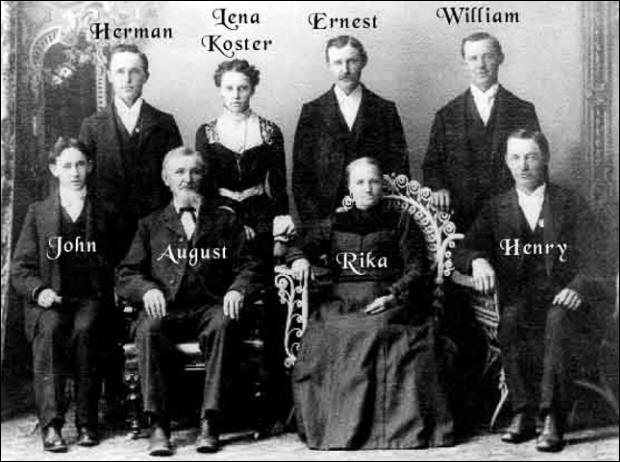
Lena (Koster) was the only girl in Pa’s family.
Wilma (Heiden) Bicking - Talking about the cherry soup. Whenever I mention that to
someone, they act like I have rocks in my head but it was very good.
|
|
|
|
|
|
|
 |
|
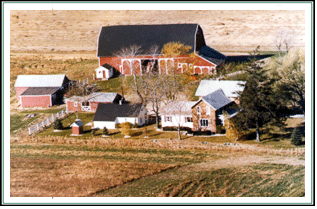 Mary Lou (Heiden) Opfermann - You say they bought the
house in 1909? I thought
Great Grandpa built the house. Mary Lou (Heiden) Opfermann - You say they bought the
house in 1909? I thought
Great Grandpa built the house.
Norma "Jeanie" Heiden -
Pa bought the place from
Meyers.
Wilma (Heiden) Bicking - Stella Graf’s grandma and
grandma built that house.
Norma "Jeanie" Heiden - I forget what Pa said they
had to pay for the farm. I think it was about $75 per acre or
something. It was 140 acres.
Helma (Heiden) Nickel - It is 141 acres. They always
had to go down to Stella’s folks, the Langs, to pay the mortgage
payments.
Norma "Jeanie" Heiden - They must have bought it on
land contract then or they wouldn’t have had to pay the Langs.
Afterwards, they got a loan from Monroe County Bank. I was still
in high school when they finally paid it off. That would have
been in the early 1940's, maybe 1941 or so.
Sometimes they would have to
borrow money to pay the taxes. Fortunately, Gilbert Oyer at the
bank knew all those farmers and he knew they were good for it.
He’d loan them the money for the taxes but then they would not
be getting any of the principal down on the loan that year.
Ralph Heiden - I have some
old property tax receipts that my great grandfather,
August Heiden, paid from the late 1800's to about 1911.
Mary Lou (Heiden) Opfermann - Where did they live
then?
Helma (Heiden) Nickel - Over on
South Custer where
Uncle John and Aunt Agnes
(Brockman) Heiden
lived.
Ralph Heiden - The property tax form says that
August Heiden's
property on South Custer Road was bordered on the north by Jacob
Mathis, on the east by George Rath and William D. Miller, and on
the west by
Ernst "Ernest" Heiden. In some of the older
receipts, it says they were bordered on the north by W. Stock,
on east by C. Rath and on the west by K. Opfermann.
Norma "Jeanie" Heiden - K. Opfermann?
Helma (Heiden) Nickel - Killian Opfermann would be
Frank’s dad.
Wilma (Heiden) Bicking - Did William and Helen
ever have a survey done on the home farm?
Ralph Heiden - Yes, they wrote in their letter that
they have a copy of the title search.
Norma "Jeanie" Heiden - That’s what I do for a
living. I’ve been doing it since April 3, 1946 and worked until
April 30, 1989. Now I work part-time at it.
Wilma (Heiden) Bicking - We’ll have to have a big
party next year to celebrate Jeanie working 50 years.
|
|
|
|
|
|
|
 |
|
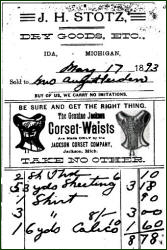
Ralph Heiden - There are a bunch of
old receipts in the material
Aunt Agnes
gave me back in the early 70's. One is from a Dr. Francis Alter, an
eye doctor from Toledo. It is for 1923 for
Mrs. August Heiden. She
had an eye examination for 5 dollars, lenses 12 dollars and eye
treatment 3 dollars.
Norma "Jeanie" Heiden - I can’t imagine the Heidens going all the way to Toledo for
an eye doctor back then. They must have had some money. I always
thought the Heidens were poor.
Helma (Heiden) Nickel - There weren’t too many eye doctors around then.
 Mary Lou (Heiden) Opfermann - See where we inherited our bad eyes from?
Now, where did you get those papers and receipts? Mary Lou (Heiden) Opfermann - See where we inherited our bad eyes from?
Now, where did you get those papers and receipts?
Ralph Heiden - From Aunt Agnes twenty some years ago.
Norma "Jeanie" Heiden - Are you going to put all that stuff in the book?
Ralph Heiden - No, but I will pick out some of the more important items and
put them in. For the
German documents, I will put the German version
on one side and then the English translation on the opposite page so
people can see what they said.
What I would like to have in this is everything people want to share
so people in the future can find out these things. Like you were
saying earlier, we often look back and think, “Boy, I wish I had
asked them about this. But, now, it is too late.”
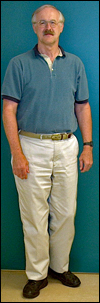 Wilma (Heiden) Bicking - I always had short legs and I could always remember Ma would
get Pa pants that would fit his waist but they would always be too
long. She would say to him, “You don’t have any legs!” Wilma (Heiden) Bicking - I always had short legs and I could always remember Ma would
get Pa pants that would fit his waist but they would always be too
long. She would say to him, “You don’t have any legs!”
Ralph Heiden (right) - That must be where I get my proportions. I am
six foot three
and I only wear a 31 inch inseam which is pretty short for someone
my height.
Norma "Jeanie" Heiden - You’ve got all your height above your waist.
Mildred (Roggerman) Heiden - You’ve got your dad’s proportions.
Pat (Bicking) Klass - I’m long waisted too and I have a heck of a time with clothes
sometimes. An empire waist on me was nothing.
\ |
|
|
|
|
 |
|
|
|
 |
|
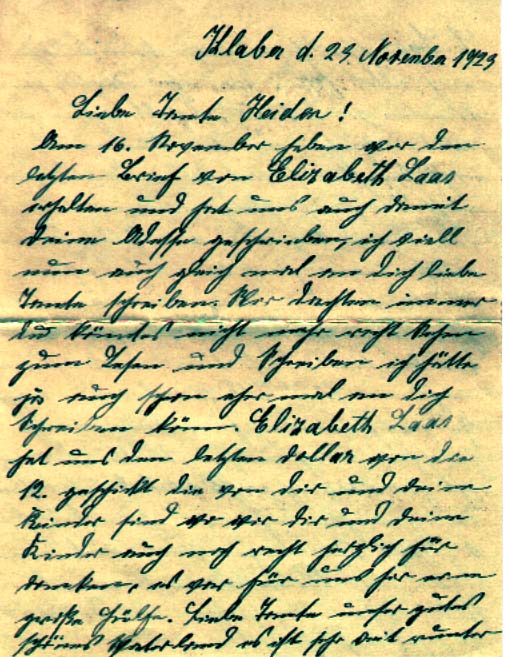
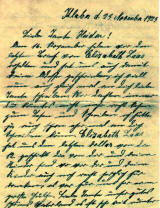 Ralph Heiden - The letters are rather sad overall. They were having some
very tough times in Germany then and they were always asking their
Aunt Rika, my great grandmother, for money. Ralph Heiden - The letters are rather sad overall. They were having some
very tough times in Germany then and they were always asking their
Aunt Rika, my great grandmother, for money.
Mildred (Roggerman) Heiden - In one of them, they ask for some money for a house and
some land. Then, later they say they bought the house but needed
more money for the land.
Marie (Heiden) Tommelein - Did they ever help them?
Ralph Heiden - Yes, they sent money when they could and they were always
very appreciative of it and told what the money would buy.
Brick Tommelein - My dad said that at that time, everyone over in Europe
called America “the land of opportunity.”
Ralph Heiden - A lot of people here were helping their relatives then too.
In one of the letters, they ask Rika to send her letters registered
because people were stealing things from mail from America because
those envelopes were likely to have money in them.
Helen (Henning) Heiden - Now are these letters all from
Mecklenburg?
Ralph Heiden - Yes. They are from the area called Mecklenburg and the port
city of Rostock. The little villages where our ancestors came from
are the size of
Grape and Maybee and they are about 50 miles from
Rostock.
 Helen (Henning) Heiden - From the Hennings, I heard them say that the people were
like slaves back then in Germany. They worked for all these big rich
people. They provided pay for them and took care of them but they
couldn’t get ahead. They didn’t want them to get married because
there were already too many of them to take care of. That is where
the Hennings came from too. Helen (Henning) Heiden - From the Hennings, I heard them say that the people were
like slaves back then in Germany. They worked for all these big rich
people. They provided pay for them and took care of them but they
couldn’t get ahead. They didn’t want them to get married because
there were already too many of them to take care of. That is where
the Hennings came from too.
Mildred (Roggerman) Heiden - Didn’t you say that our name should be something other
than Heiden?
Ralph Heiden - Yes, my great grandmother,
Maria Heiden, did not marry the
father of August. So, he took her name rather than his father’s
which was
Kanseyer
or Canseyer.
Helen (Henning) Heiden - That’s the same way with my grandpa Henning. Grandma wasn’t
married when she had those two kids.
Ralph Heiden - That was a real common occurrence back then.
Mildred (Roggerman) Heiden - They wouldn’t let you get married unless you could support
yourself.
Ralph Heiden - They technically weren’t slaves but there was nowhere else
for them to go except to another big estate to work and they were
full too. Also, the landowner had the responsibility to take care of
the people on his land so he was stuck too.
That is why they pushed a lot of them to leave and go to America.
Also, the illegitimacy rate went way up because even though they
weren’t legally allowed to marry, people continued to form couples
and do what they needed to do.
Helen (Henning) Heiden - You wonder why the Heidens would come here but they said on
the Henning side that they would send money back to Germany to help
others come here.
Ralph Heiden - But with the Heidens, we don’t know who was here to pave the
way for them. Maybe with this Laas connection, there might be
something to go on.
The
Rambows came a year later. They came here in 1874 and I don’t
know if they came from the same part of Germany as the Heidens. I
haven’t looked into that yet. (See the note below)
I think about the only way we are going to learn why the Heidens
came here is if we stumble onto somebody in one of the other
branches that has an old box of papers up in the attic that someone
gave them long ago. Otherwise, the reason may be lost to history.
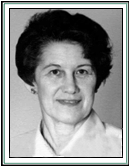 Mary Lou (Heiden) Opfermann - You might get something from
Caroline Brown
(right) too. Helma was
going to check with her. She and her husband, Bill, used to attend
all the old reunions. He used to take movies of the reunions. She is
somehow related to the Laas side. Mary Lou (Heiden) Opfermann - You might get something from
Caroline Brown
(right) too. Helma was
going to check with her. She and her husband, Bill, used to attend
all the old reunions. He used to take movies of the reunions. She is
somehow related to the Laas side.
William Frank Heiden - She was
Uncle John Laas’ daughter.
Marie (Heiden) Tommelein - She came to our place in Florida one time looking for
Helma’s address.
Ralph Heiden - Perhaps she would have the old films laying around
someplace. We could put them on videotape.
Marie (Heiden) Tommelein - I don’t remember him taking movies.
Mary Lou (Heiden) Opfermann - Oh, yes. Don’t you remember everybody trying to duck out
of the way all the time?
Helen (Henning) Heiden - You know,
Aunt
Agnes probably had some old papers.
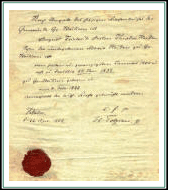 Ralph Heiden - Yes, that is where I got a lot of these old documents. They
had the names of the old villages in Germany where August and his
wife and three of their children were born. There was also a
document that I think is August’s
discharge paper from the army. He
served from 1859 to 1861. Ralph Heiden - Yes, that is where I got a lot of these old documents. They
had the names of the old villages in Germany where August and his
wife and three of their children were born. There was also a
document that I think is August’s
discharge paper from the army. He
served from 1859 to 1861.
Mildred (Roggerman) Heiden - His
naturalization papers were there too.
Ralph Heiden - Yes, the papers
where he applied for citizenship and then was granted U.S.
citizenship.
|
|
Further
research by
Karen (Berns) Wheaton
and myself found that the Rambows and Heidens lived
in the same little village of
Gross Wokern, Germany. Caroline Brown's maiden
name was Laas. |
|
|
|
|
|
 |
|
 |
 Over
the years, we have also received written memories and
remembrances about this person or topic from various family
members. Over
the years, we have also received written memories and
remembrances about this person or topic from various family
members. |
|
 |
 |
|
| |
|
| |
|
| |
|
|
|
|
|
|
 |
|
 |
|























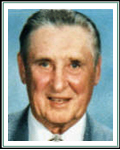
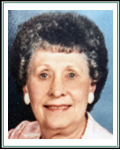
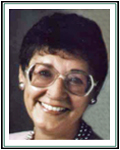
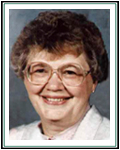
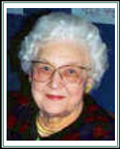
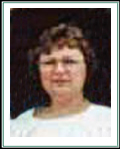
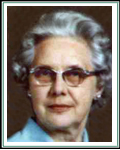
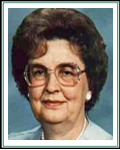
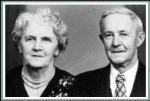 Wilma, Jeanie, Wm Frank, Helma & Marie were
children of
Wilma, Jeanie, Wm Frank, Helma & Marie were
children of